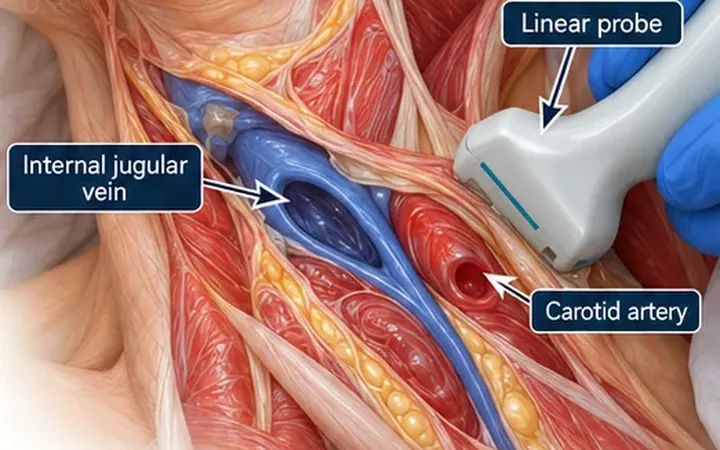
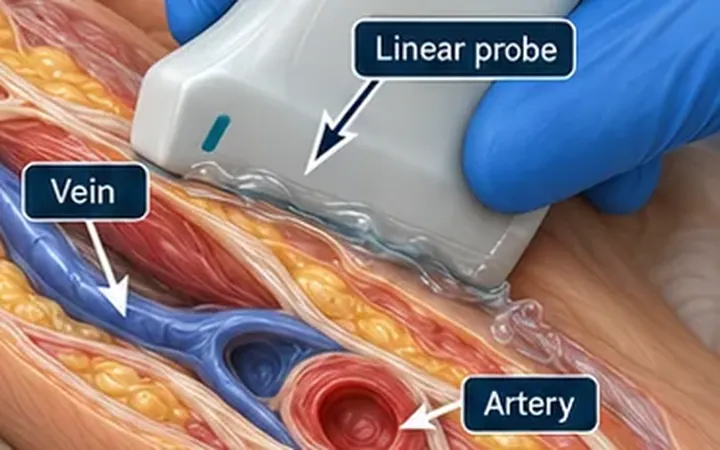
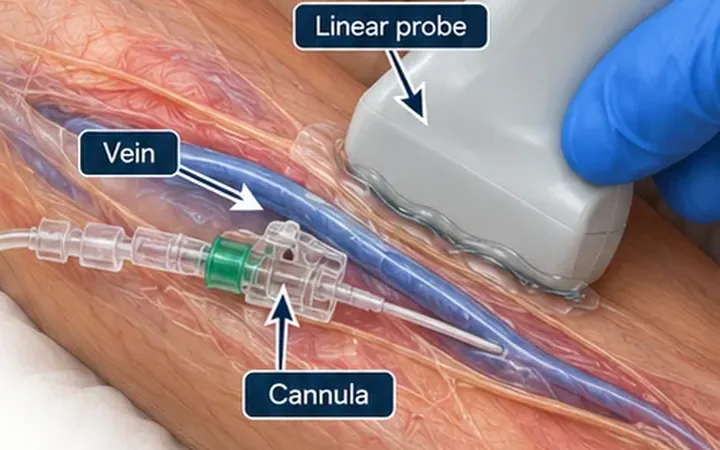
You see the vein, you get a flash, and the catheter will not advance. Pushing harder is the wrong answer. A catheter can fail to thread even when the needle tip is close to the lumen, and a blind push can dissect beside the vein and leave you with a swollen arm and no line.
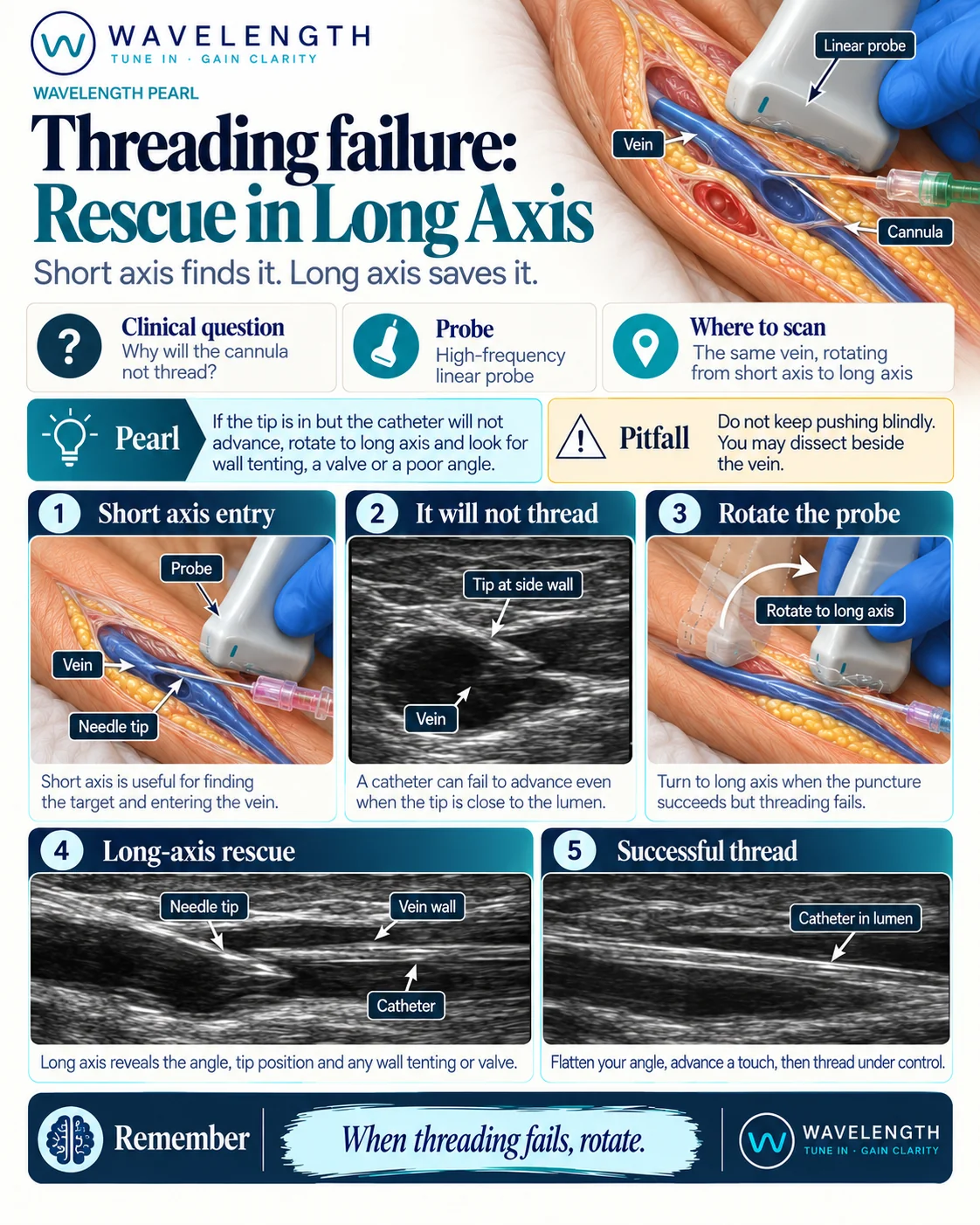
Scan images in the graphic are illustrations, not patient scans.
The scan
- Enter the vein in short axis, which is the easiest view for finding the target and entering it.
- If the catheter will not advance, stop. Keep the needle still.
- Rotate the probe through 90 degrees to long axis, so you see the vein as a tube with the needle in it.
- Look at three things: where the tip sits, whether the wall is tented or the tip is against the side wall, and whether a valve or a bend lies ahead.
- Flatten your angle so the needle runs along the vein, not into its wall.
- Advance the needle a few millimetres, so the tip is well inside the lumen and the catheter tip follows it.
- Advance the catheter off the needle under vision. If it still meets resistance, stop and reassess.
Reading the view
- Tip at the side wall. The bright tip touches the vein wall and the catheter cannot pass.
- Catheter in lumen. A bright line running along the centre of the black tube.
- A valve or a bend. A thin echogenic leaflet in the lumen, or a sudden turn of the vein.
When to stop
If the catheter will not pass after you have corrected the angle, take it out. Choose a different segment or a different vein, and follow your trust's policy on the number of attempts before you ask for help.