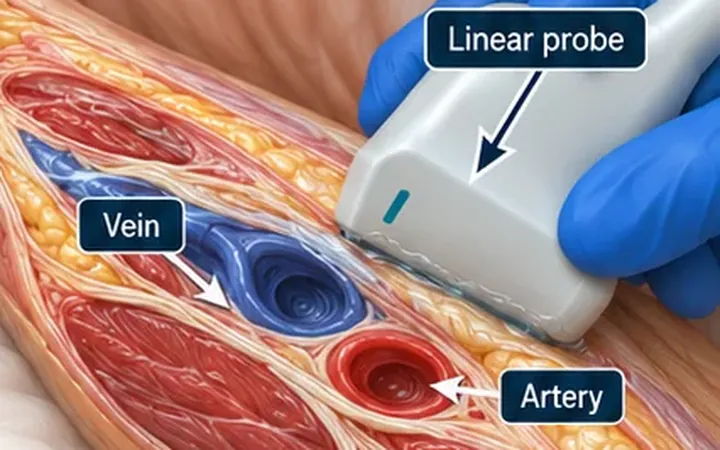
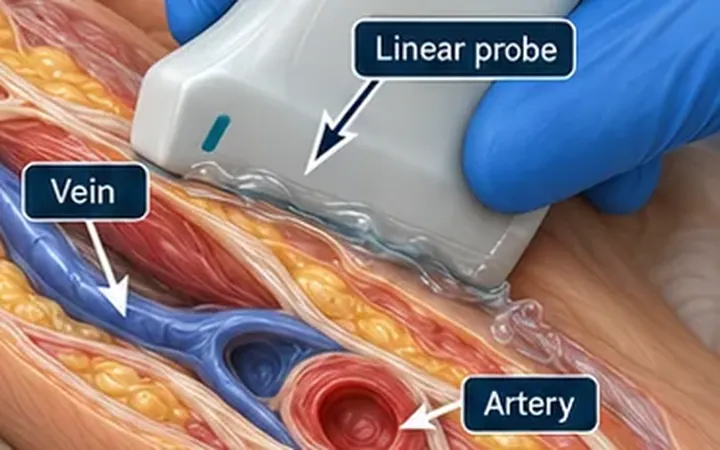
A puncture that succeeds and a catheter that will not thread usually means the wrong segment, not the wrong technique. Hidden branches, valves and sharp turns stop the catheter. A deep vein holds only the tip of a short catheter, which then falls out. A minute spent surveying the arm picks a vein that works first time.
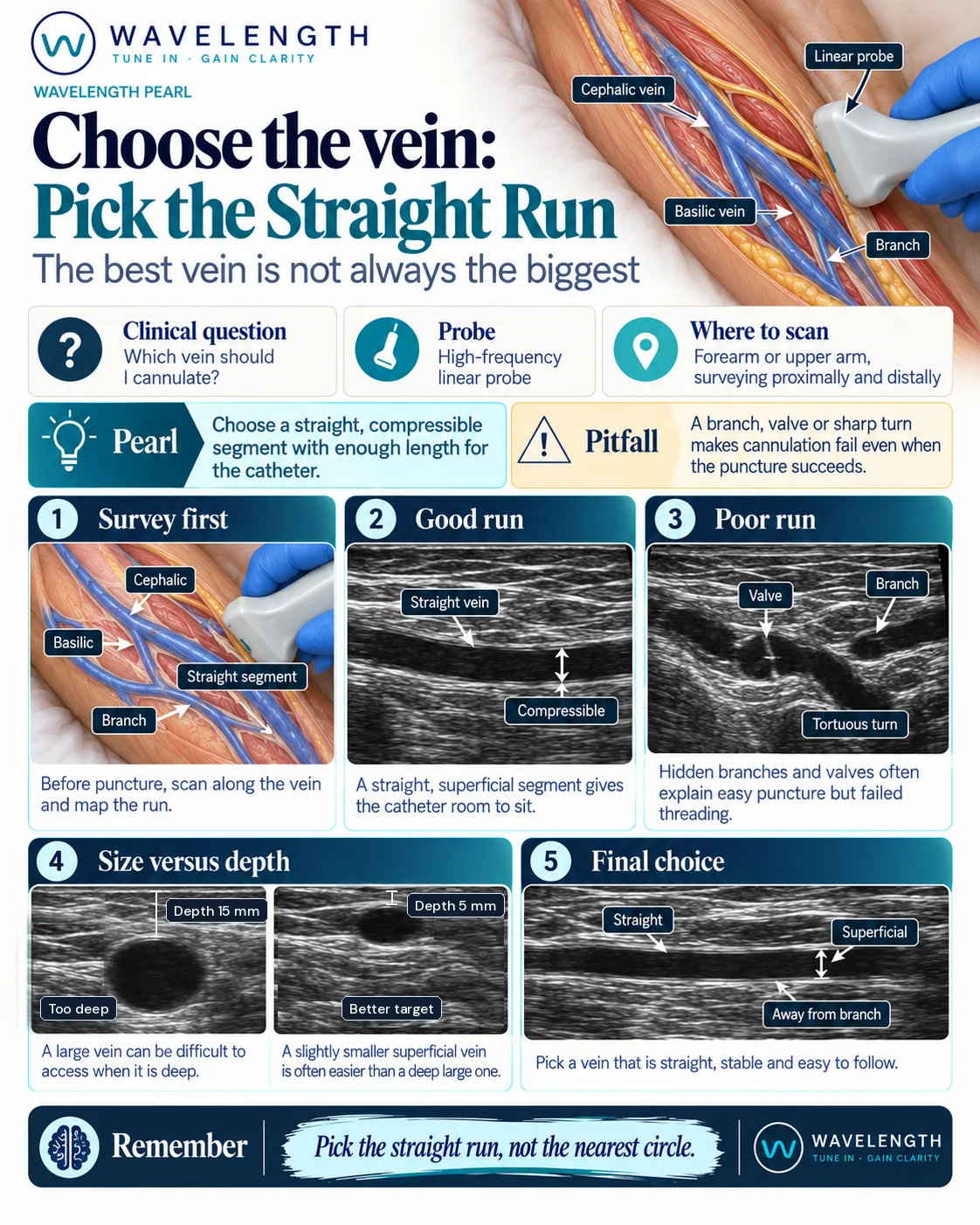
Scan images in the graphic are illustrations, not patient scans.
The scan
- Apply a tourniquet. Scan the forearm and upper arm in short axis, moving proximally and distally.
- Map the run of each candidate vein: where it branches, turns or dives deep.
- Compress each candidate to prove it is a vein and free of clot.
- Turn to long axis over the best candidate. Look for a straight run, with no valve or branch, over the length of your catheter.
- Measure the depth from the skin to the top of the vein.
- Choose the segment which is straight, compressible, superficial enough and easy to follow.
Depth and catheter length
The catheter needs enough length inside the vein to stay there. A 2020 emergency department study found that peripheral catheters lasted longer when more than 2.75 cm of the catheter lay inside the vein. A standard short cannula through 1.5 cm of tissue leaves little in the lumen. For a deeper vein, choose a longer catheter if your trust stocks one, or pick a more superficial vein.
Reading the view
- Good run. A straight, black tube in long axis, compressible, with a clear wall.
- Poor run. A valve leaflet in the lumen, a side branch, or a tortuous turn.
- Size versus depth. A large vein 15 mm deep is often harder than a smaller one 5 mm deep.
Nerves and arteries
In the upper arm, the basilic vein runs near the brachial artery and the median nerve. Know what lies beside and beneath your target before you choose it.