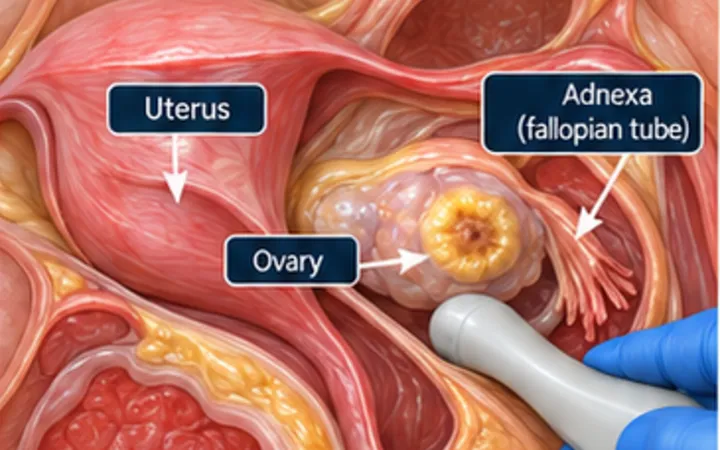
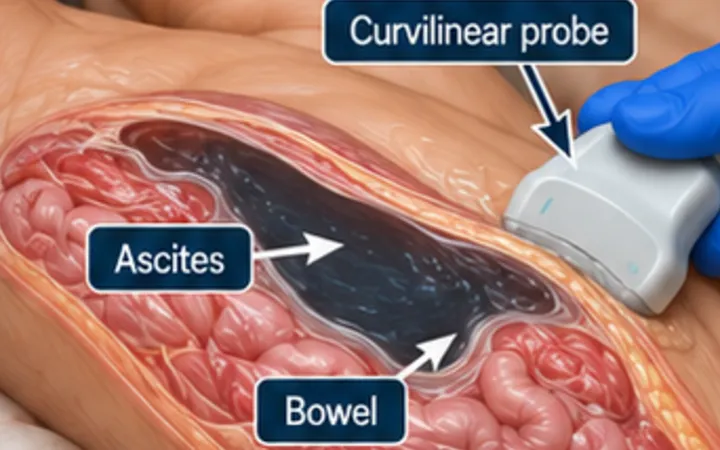
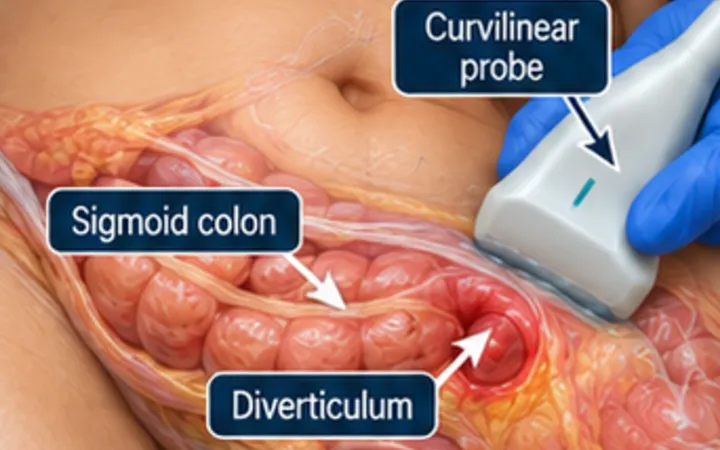
When a urethral catheter cannot be passed, a suprapubic catheter or a suprapubic aspiration drains the bladder. The main serious risk is bowel caught between the abdominal wall and the bladder, especially after previous lower abdominal or pelvic surgery. National guidance recommends ultrasound to confirm a safe window. The same scan in a child confirms enough urine before a suprapubic aspirate.
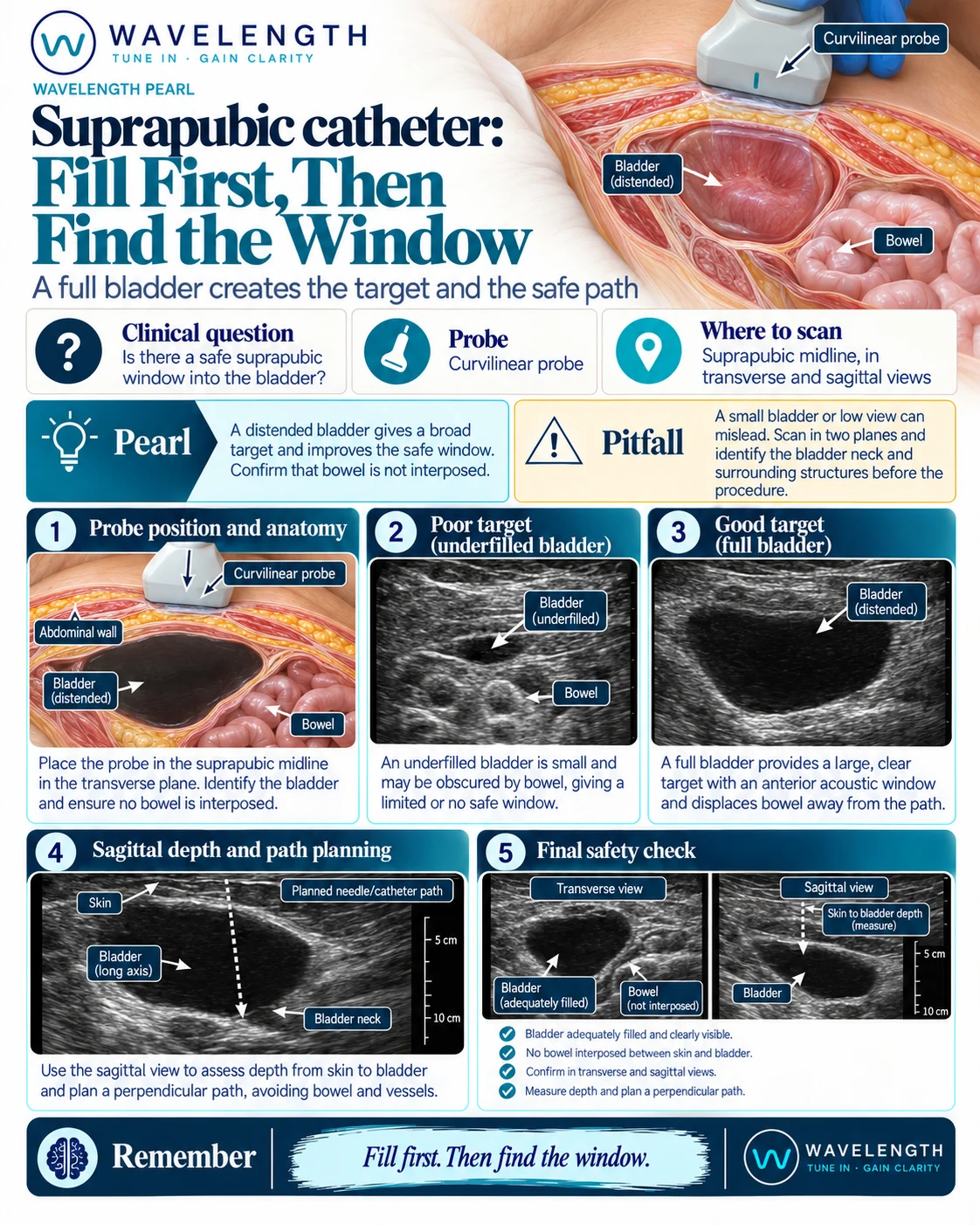
Scan images in the graphic are illustrations, not patient scans.
The scan
- Use the curvilinear probe in the midline just above the pubic symphysis, first in transverse, then in sagittal.
- Confirm the bladder is full: a large black structure with a wall, rising above the symphysis.
- Sweep through the whole planned path and look for bowel: loops with gas, a layered wall and movement between the skin and the bladder.
- In sagittal, measure the depth from skin to the bladder lumen at the planned site, usually about two fingerbreadths above the symphysis.
- Mark the site and keep the patient in the same position.
Reading the view
- Good window: a full bladder directly under the abdominal wall, with no bowel in the path in either plane.
- Poor window: a small bladder deep in the pelvis, with bowel loops lying in front of it.
- Scars and previous surgery: adhesions can hold bowel in front of even a full bladder. Look extra carefully.
Action
Insert a suprapubic catheter only if you are trained to do so and local policy allows it, usually with urology support. If the bladder is not full, wait for it to fill or fill it through an existing catheter, then scan again. Record the depth and the views you used.