The testis is wrapped in a tough fibrous capsule, the tunica albuginea, which shows on ultrasound as a thin bright line. A blunt injury can bruise the testis inside an intact tunica, or tear the tunica so that testicular tissue pushes out. Ruptured testes are usually saved when repaired early, so the outline matters more than the bruise.
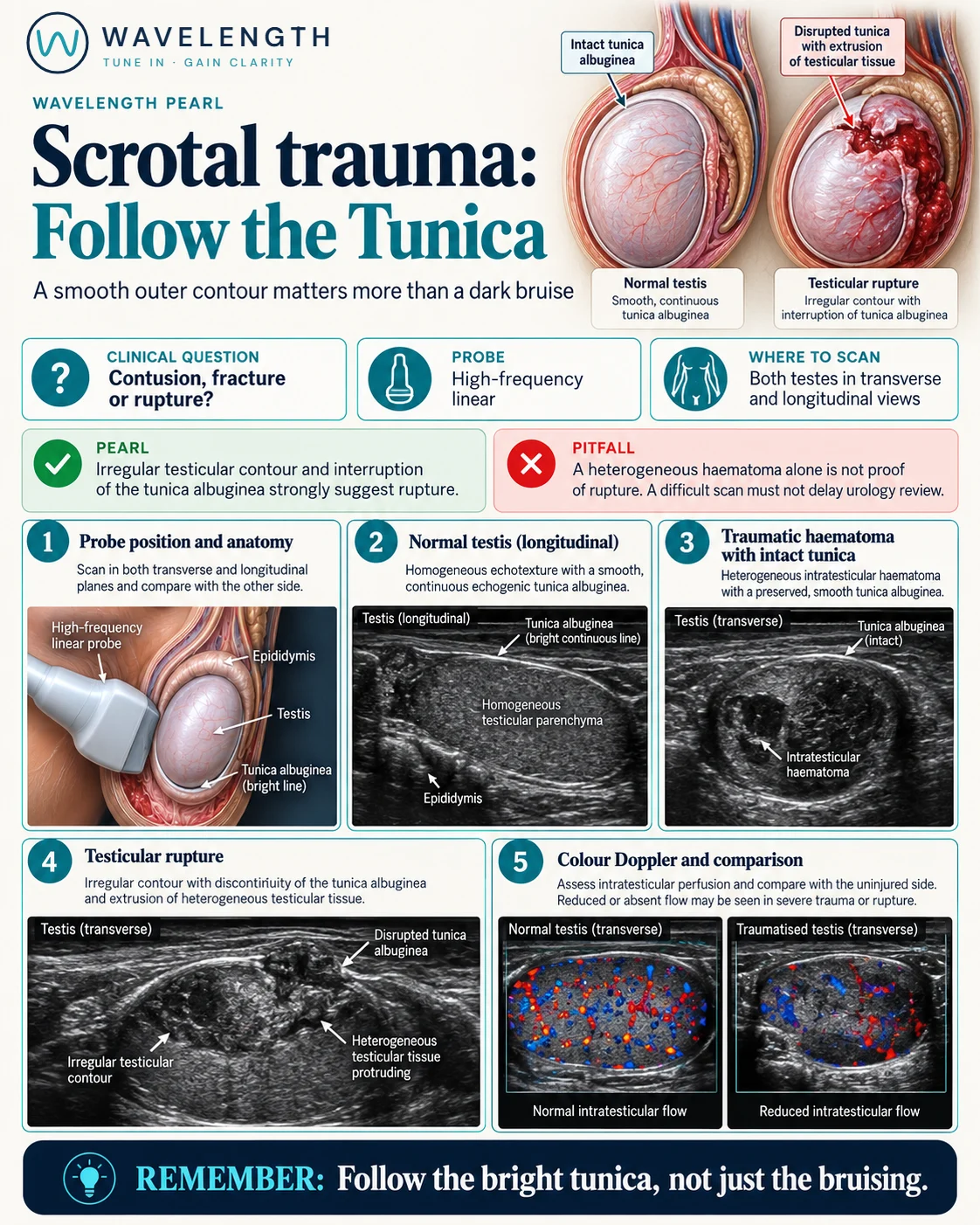
Scan images in the graphic are illustrations, not patient scans.
The scan
- Explain the scan, offer a chaperone and record the offer. Give analgesia first.
- Support the scrotum on a rolled towel. Use a high-frequency linear probe with plenty of warm gel and very little pressure.
- Start on the uninjured side to set the grey-scale and colour settings.
- On the injured side, follow the bright tunica all the way round the testis in transverse and long axis.
- Look at the texture inside the testis, and at any fluid around it.
- Add colour Doppler and compare the flow with the other side.
Reading the view
- Intact tunica: a smooth, continuous bright line around the testis.
- Contusion or haematoma: an area of mixed or dark texture inside the testis, with the tunica still smooth and complete.
- Rupture: a break in the tunica, an irregular or lumpy outline, or testicular tissue pushing out through the gap. Often with blood around it (a haematocele) and reduced flow in part of the testis.
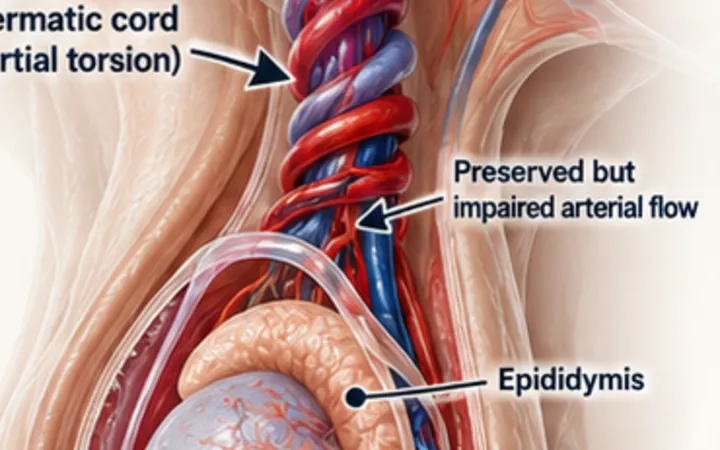
- Other findings: a haematocele alone, an injured epididymis, or a twisted cord after trauma.
Action
Suspected rupture needs urgent urology review for exploration, ideally within hours. A large haematocele, a testis you cannot assess, or severe pain also needs urgent urology review. Remember that torsion can follow a minor injury. See also Scrotal fluid: clear or complex?.