A swollen scrotum is often full of fluid, and fluid is a good window onto the testis. A simple hydrocele is usually harmless. Complex fluid, with debris or septations, suggests infection or blood. The more important finding may be the cause behind the fluid: torsion, infection, a ruptured testis after trauma, or a tumour.
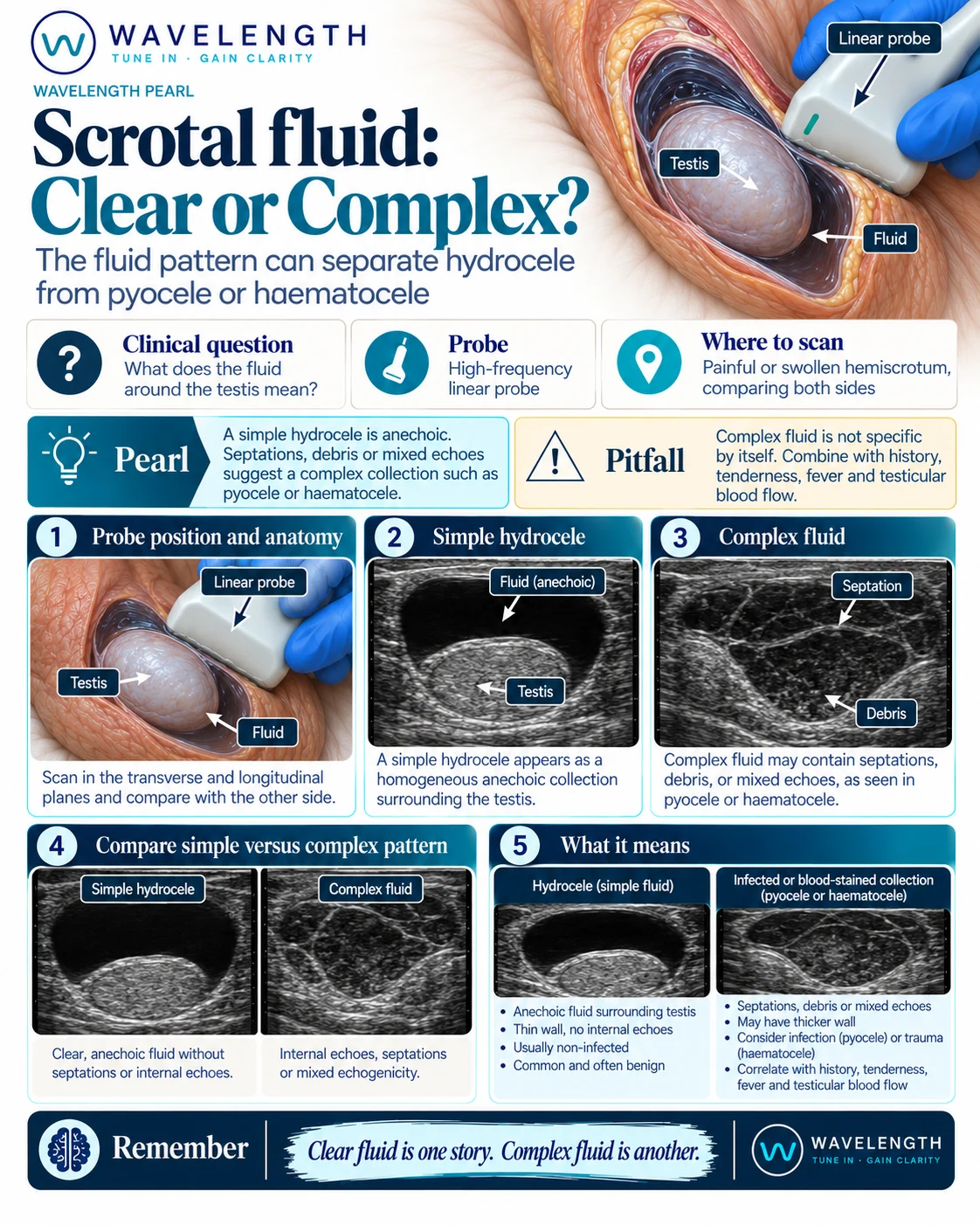
Scan images in the graphic are illustrations, not patient scans.
The scan
- Explain the scan, offer a chaperone and record the offer.
- Support the scrotum on a rolled towel. Use the linear probe with warm gel.
- Start on the normal side to set the grey-scale and colour settings.
- Scan the fluid in two planes. Look for echoes, strands and septations.
- Look at the testis through the fluid: its outline, its texture and its blood flow, compared with the other side.
- Follow the spermatic cord, and look into the groin for bowel in a hernia.
Reading the view
- Simple hydrocele: black fluid around the front and sides of the testis, with no echoes.
- Complex fluid: debris, fine strands or septations. With fever and tenderness, think of a pyocele; after trauma, think of a haematocele.
- Testis after trauma: a broken outline or an uneven, disorganised testis inside a haematocele suggests rupture.
- Reactive fluid: a small hydrocele often accompanies epididymo-orchitis, torsion and torsion of an appendage.
Action
Possible torsion goes to urology at once, without waiting for a scan, as in the testicular torsion pearl. A haematocele after trauma, especially with a broken testicular outline, needs urgent urology review because a ruptured testis is repaired early. A pyocele needs urology review and antibiotics. A testicular mass needs an urgent suspected cancer referral.