Torsion is not always complete. When the cord twists less than a full turn, or twists and untwists, venous outflow is blocked first and the arteries may still fill. Colour Doppler can then show flow in a testis that is losing its blood supply. This is why a normal-looking colour scan never clears torsion. See the testicular torsion pearl for the whirlpool sign.
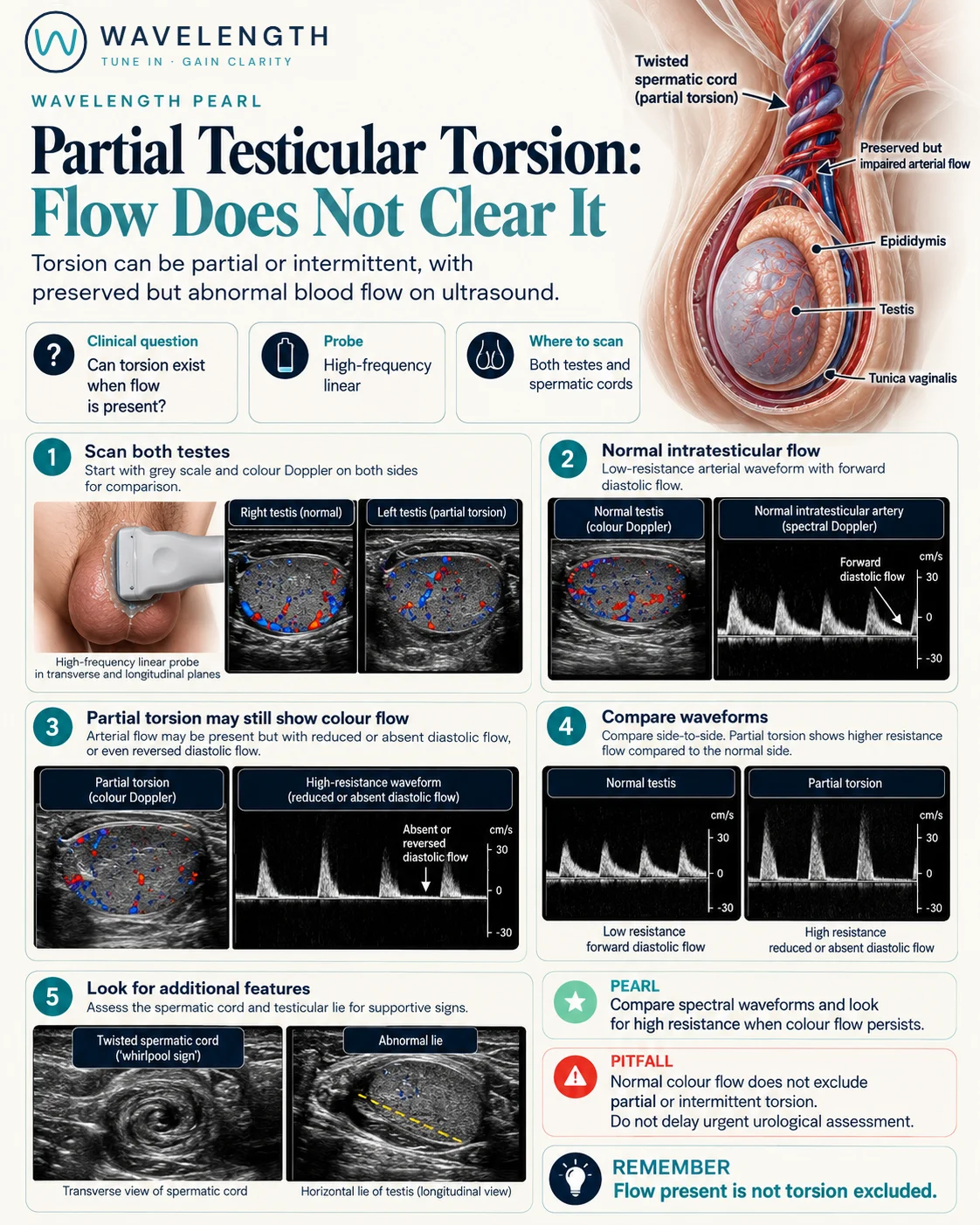
Scan images in the graphic are illustrations, not patient scans.
The scan
- Call urology first if torsion is likely on clinical grounds. Scan while they come, not instead.
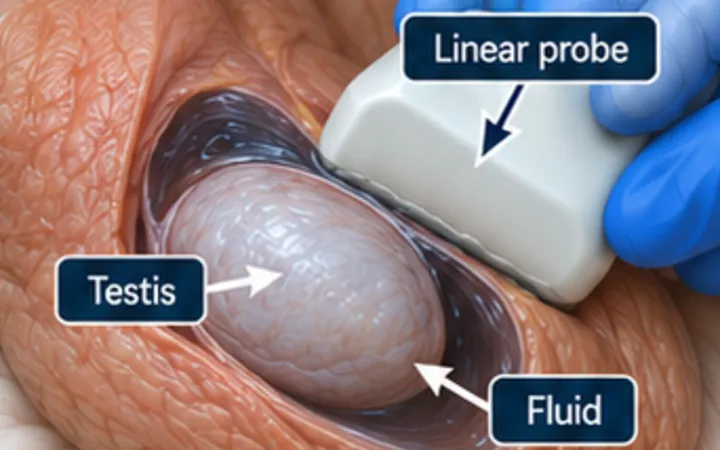
- Use a high-frequency linear probe. Start on the painless side to set the grey-scale and colour settings.
- Compare colour flow in both testes with the same settings.
- If you can, put a pulsed-wave Doppler gate on an artery inside each testis and compare the waveforms.
- Follow the spermatic cord up from the testis in short axis, looking for a twist.
- Note the lie of the testis and its texture compared with the other side.
Reading the view
- Normal: symmetrical flow, with a low-resistance arterial waveform that keeps flowing forward in diastole.
- Partial torsion: flow may be present but reduced, with a high-resistance waveform: reduced, absent or reversed flow in diastole, compared with the other side.
- Supporting signs: a twisted cord (the whirlpool sign), a horizontal lie, and an enlarged or uneven testis.
Action
Sudden testicular pain, especially with vomiting, a high or horizontal testis or an absent cremasteric reflex, goes to urology for exploration whatever the scan shows. Record what the scan found and how it compared with the other side.