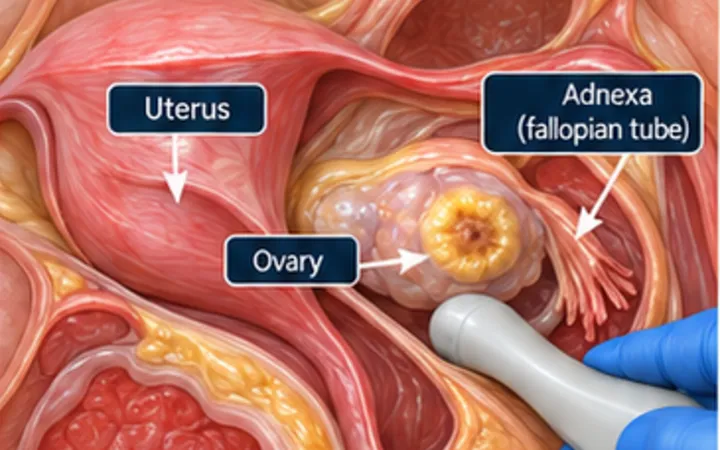
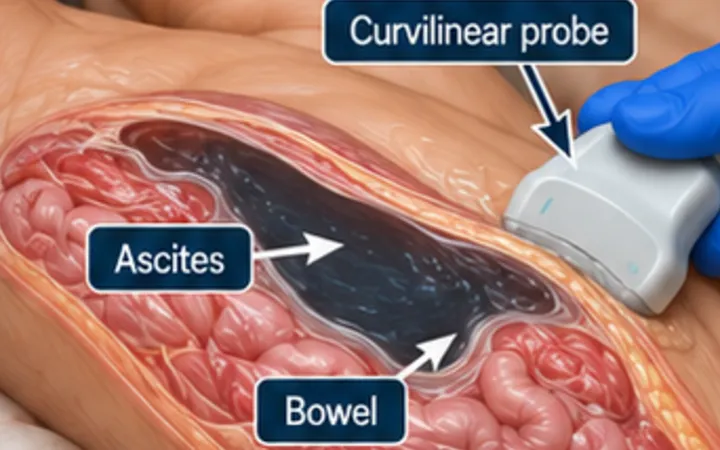
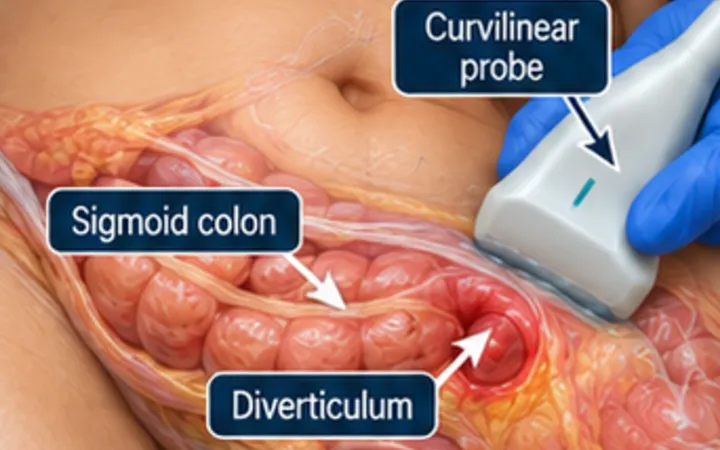
Ongoing bleeding or pain after a pregnancy has ended can come from retained products of conception, clot, infection or, rarely, a vascular malformation or trophoblastic disease. Ultrasound looks inside the uterine cavity. Colour Doppler helps most: retained tissue usually has blood flow, and clot does not.
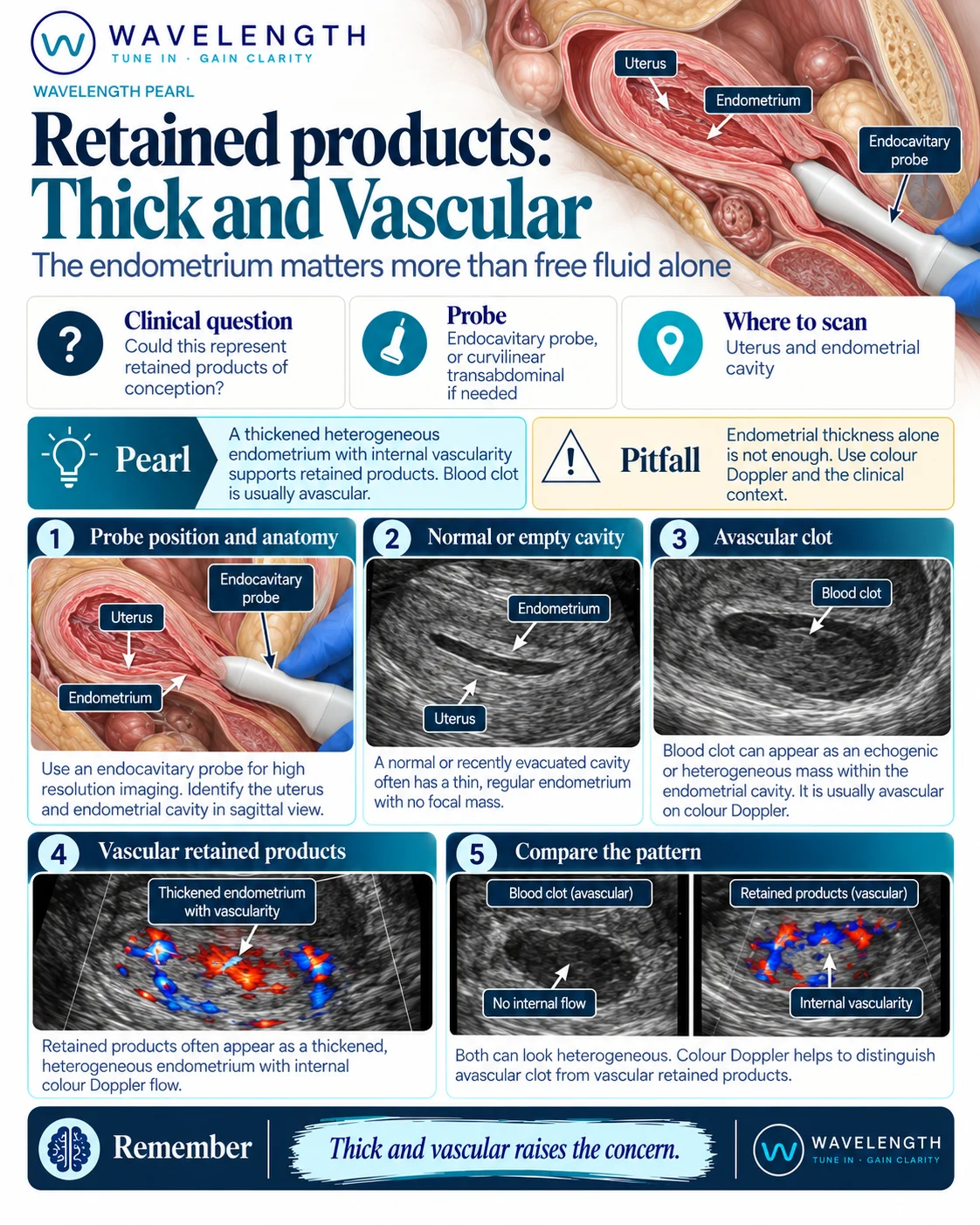
Scan images in the graphic are illustrations, not patient scans.
The scan
- Explain the scan, offer a chaperone and record the offer.
- Transabdominal first, with a full bladder if possible: curvilinear probe, the uterus in sagittal and transverse. Transvaginal scanning, where you are trained to do it, gives more detail.
- Follow the endometrium from the fundus to the cervix in the sagittal plane.
- Look at its thickness and texture, and for a focal mass in the cavity.
- Add colour Doppler with a low scale over any mass or thick area, and compare with the wall around it.
- Check the pouch of Douglas for free fluid.
Reading the view
- Empty cavity: a thin, regular endometrial line with no focal mass.
- Clot: echogenic or mixed material in the cavity, usually without internal flow. It may change shape or move.
- Retained products: a thick, uneven endometrium or a focal mass, often with blood flow running into it from the wall.
- Infection: retained products with fever, tenderness or an offensive discharge suggest an infected miscarriage, a gynaecological emergency.
Action
Heavy bleeding needs resuscitation and urgent gynaecology review, whatever the scan shows. Otherwise refer to the early pregnancy unit or gynaecology team according to local pathways, with the hCG result. Fever or signs of sepsis need urgent antibiotics and gynaecology review.