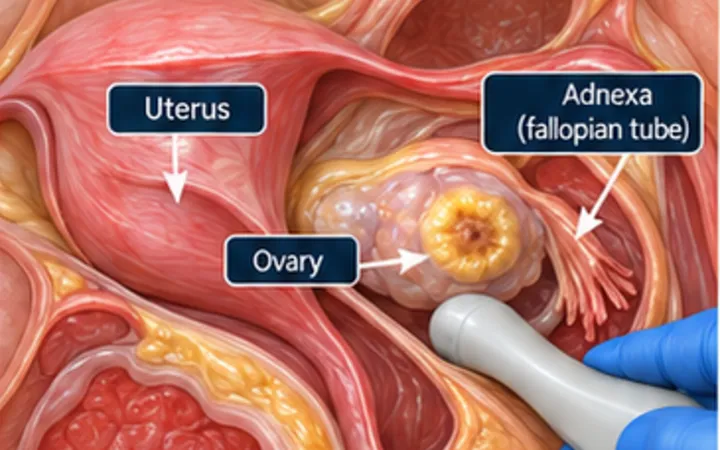
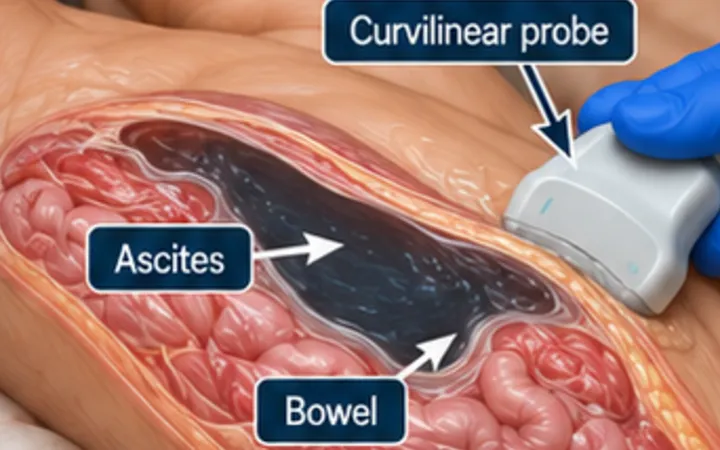
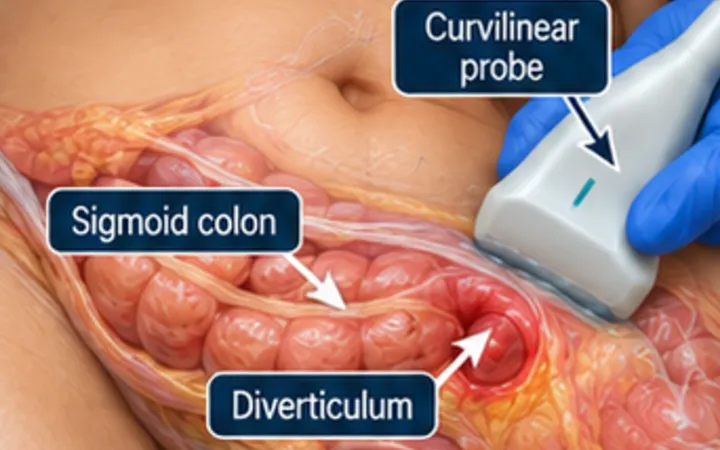
Gas in the liver shows as bright echoes, sometimes with ring-down artefact behind them. It sits in one of two places. Portal blood flows into the liver and out to its edges, so gas in the portal veins is carried to the periphery. Bile drains back towards the hilum, so gas in the bile ducts stays central. The two have very different causes.
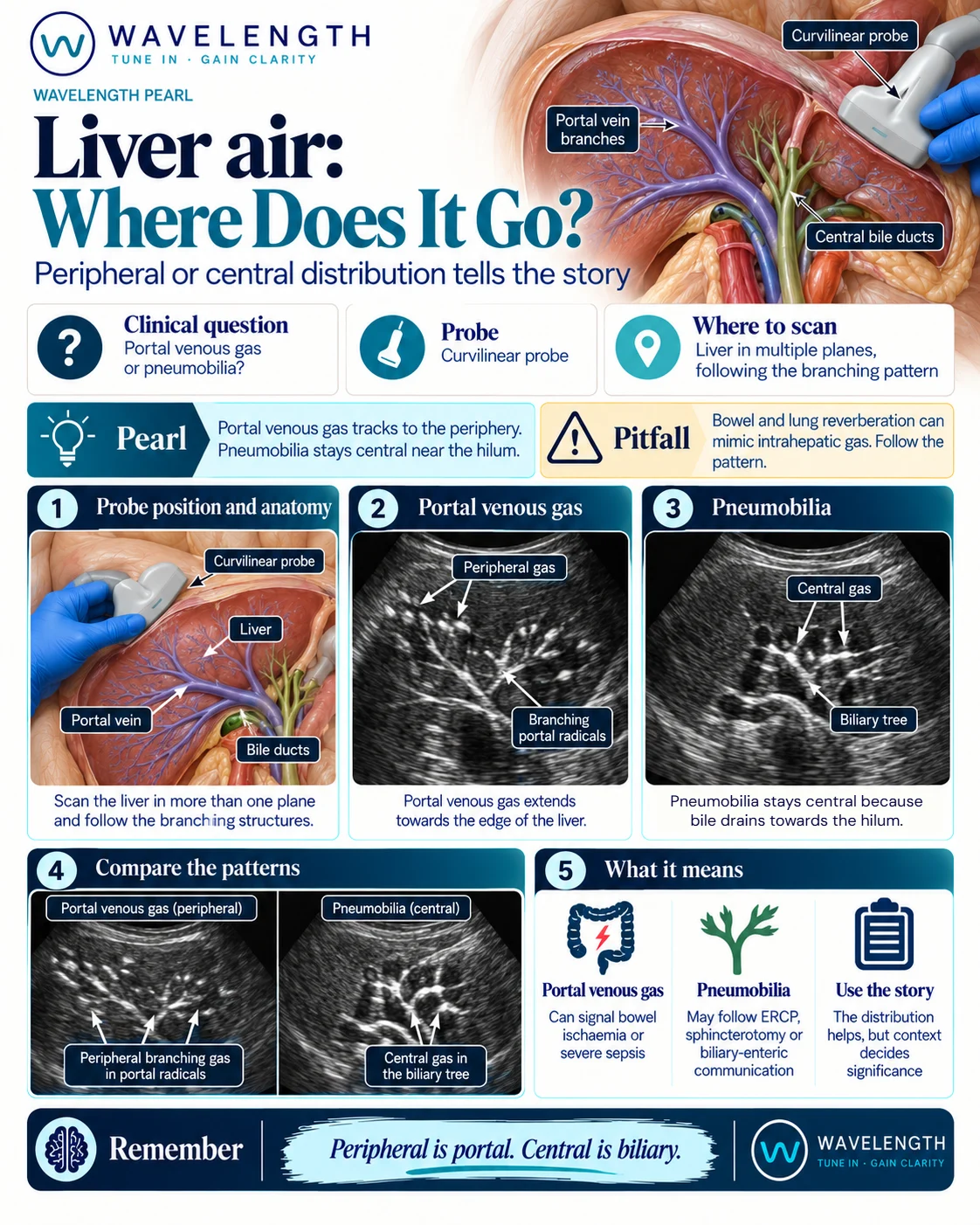
Scan images in the graphic are illustrations, not patient scans.
The scan
- Use the curvilinear probe below the right costal margin and between the lower ribs.
- Sweep through the whole liver in more than one plane.
- Find where the bright echoes are: out near the capsule, or close to the hilum along the larger ducts.
- Watch them. Gas moving with the blood flow in the portal vein is portal venous gas.
- Add pulsed-wave Doppler to the main portal vein. Gas bubbles cause sharp, bright spikes on the trace.
- Look at the gallbladder and the bowel for a cause.
Reading the view
- Portal venous gas: small bright foci spread to the periphery of the liver, within a couple of centimetres of the capsule, often moving with portal flow, with spikes on the portal vein Doppler trace.
- Pneumobilia: bright linear echoes along the central bile ducts near the hilum, often with ring-down artefact, moving little with blood flow.
- Causes of portal venous gas: bowel ischaemia, severe sepsis, necrotising enterocolitis in newborns, and less serious causes after endoscopy or with bowel inflammation.
- Causes of pneumobilia: a previous sphincterotomy or ERCP, a biliary stent or surgical join to the bowel, and rarely a gallstone eroding into the bowel.
Action
Pneumobilia after known biliary intervention is usually expected. Unexplained portal venous gas in an unwell patient, especially with abdominal pain, lactate rise or sepsis, needs urgent CT and surgical review for bowel ischaemia.