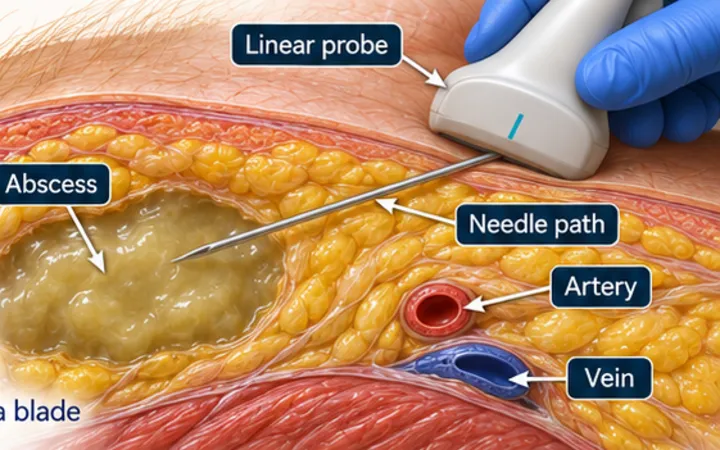
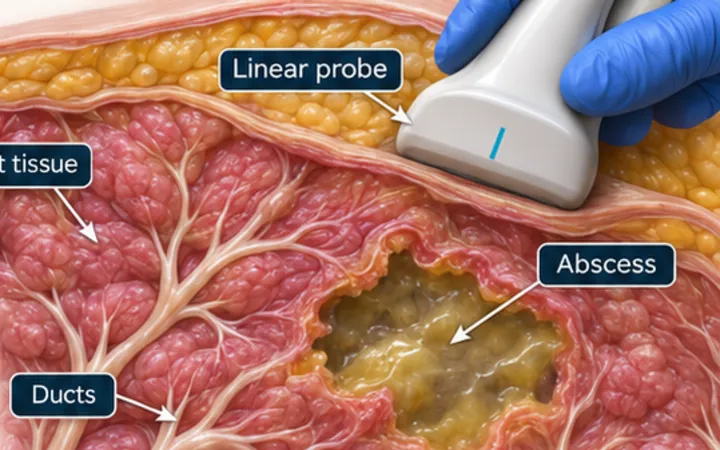
Acute suppurative parotitis is a bacterial infection of the parotid gland, usually Staphylococcus aureus, in people who are dehydrated, elderly, recovering from surgery or with poor oral hygiene. The gland becomes hot, tender and swollen, and pus may appear at the opening of the parotid duct inside the cheek when the gland is pressed. A few go on to form an abscess, which antibiotics alone may not cure. Mumps and other viral parotitis are usually bilateral and do not form pus.
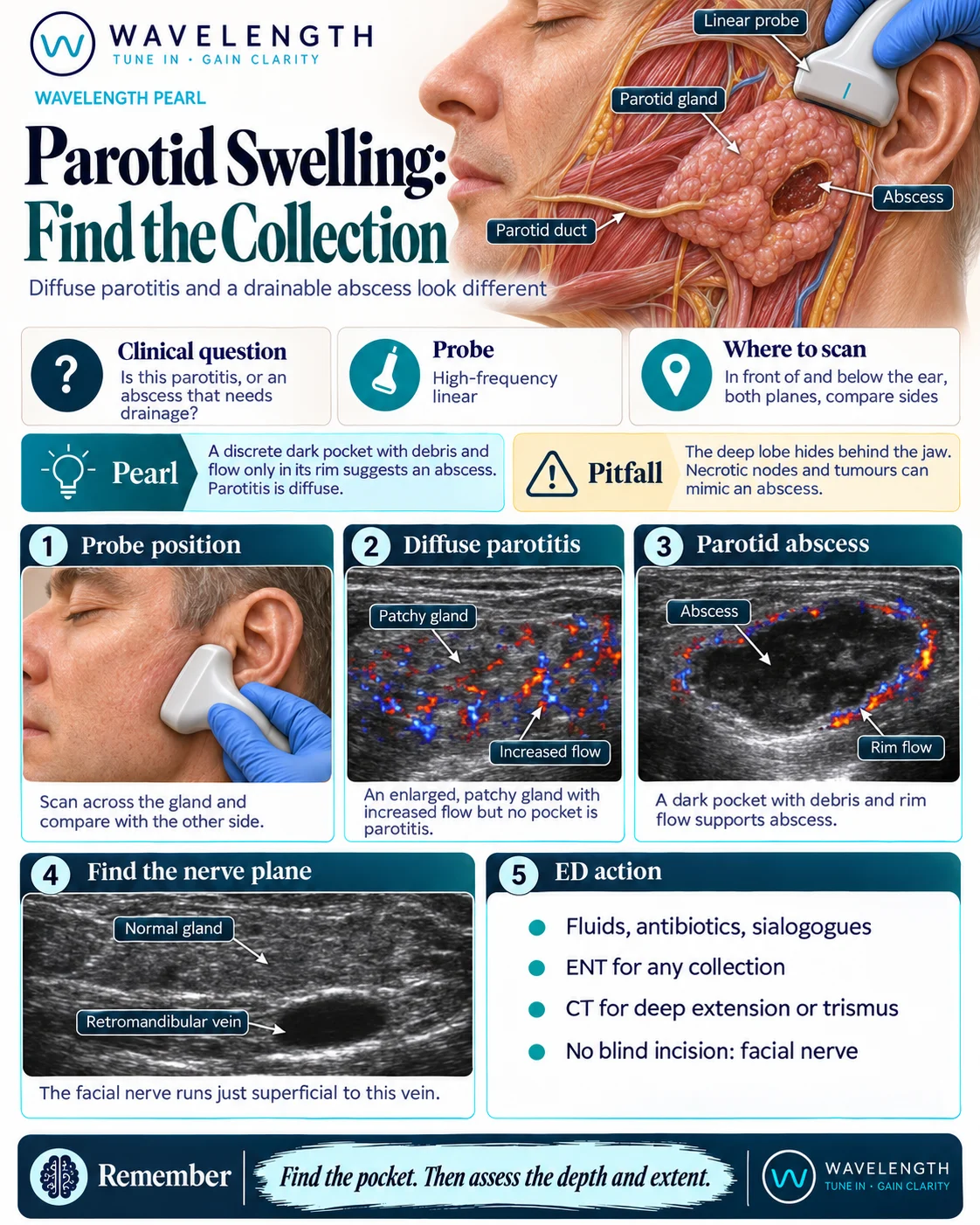
Scan images in the graphic are illustrations, not patient scans.
The scan
- Use a high-frequency linear probe over the swelling in front of and below the ear, in transverse and long axis.
- Find the gland: normally bright and evenly textured, brighter than the nearby muscle.
- Find the retromandibular vein running through the gland. The facial nerve lies just superficial to it, in the same plane.
- Sweep the whole gland, press gently, and add colour Doppler.
- Compare with the other side.
Reading the view
- Normal gland: bright, homogeneous, with the vein inside it.
- Parotitis: an enlarged, darker, patchy gland with increased colour flow, sometimes with small dark ducts or reactive nodes, but no discrete pocket.
- Abscess: a dark or complex collection with debris and an irregular wall, no flow inside it, flow in its rim, and sometimes swirl on gentle pressure.
Action
Treat parotitis with intravenous fluids, antibiotics that cover Staphylococcus aureus, sialogogues, warm massage and mouth care. A collection needs ENT review for ultrasound-guided aspiration or surgical drainage: the facial nerve runs through the gland, so no blind incision. CT shows deep extension or an uncertain anatomy. Trismus, a facial nerve weakness or spreading neck swelling need urgent senior and ENT review.