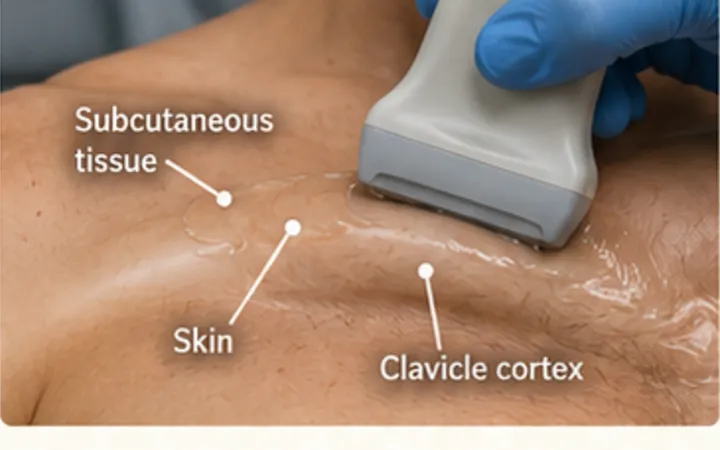
Odontogenic infection is a common cause of facial swelling in the emergency department. The question is whether there is pus to drain or cellulitis to treat with antibiotics and dental care. Ultrasound over the swelling answers it in the same way as an abscess elsewhere: look for a pocket, press for the swirl and check the flow.
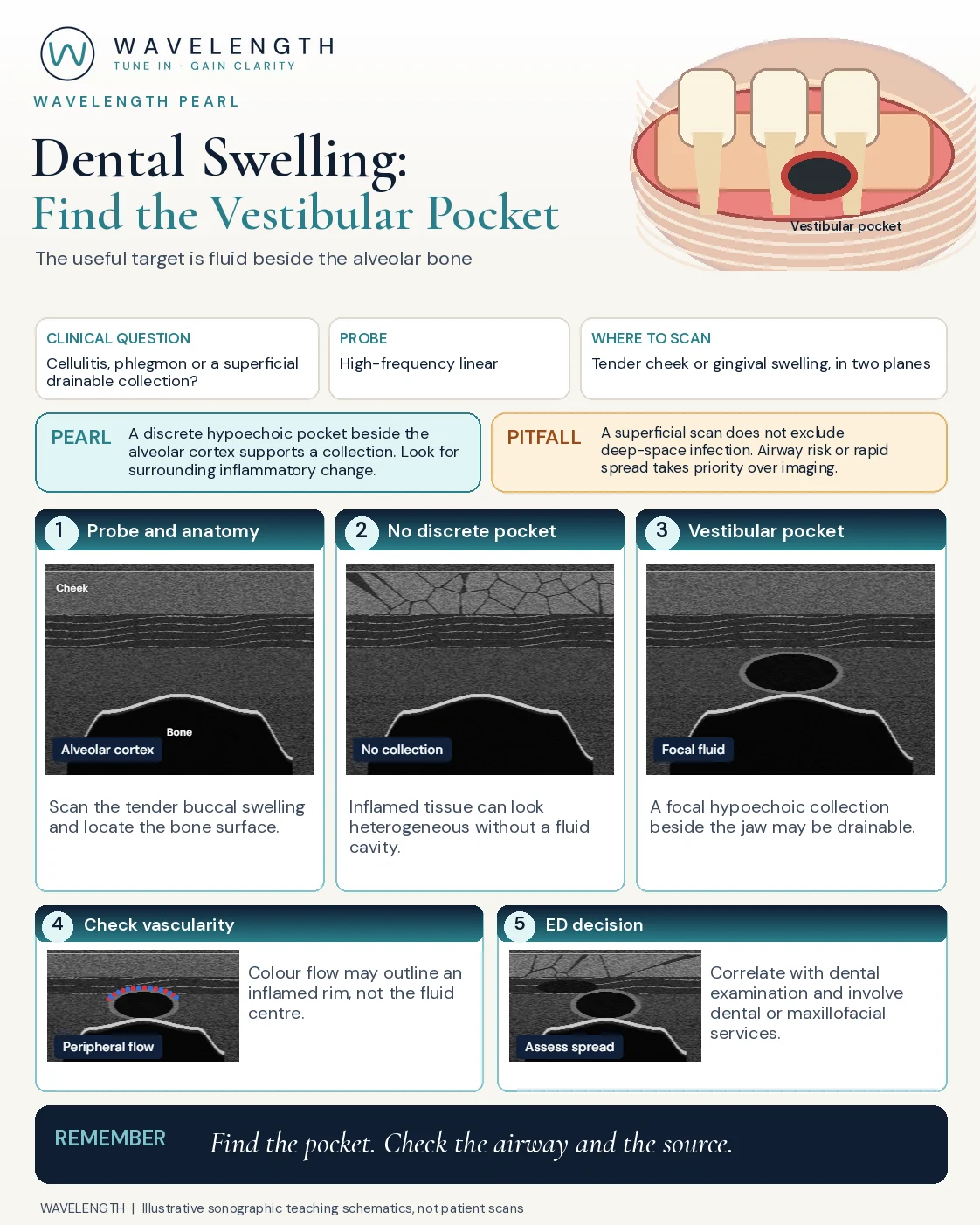
Scan images in the graphic are illustrations, not patient scans.
The scan
- Use a high-frequency linear probe on the cheek over the most tender, swollen point.
- Find the bright surface of the alveolar bone of the jaw, with its shadow.
- Sweep across the swelling in two planes, from the skin down to the bone.
- Press gently: pus may swirl.
- Add colour Doppler and compare with the other cheek.
Reading the view
- Cellulitis: thickened, brighter fat with dark strands between the fat lobules (cobblestoning) and no discrete pocket.
- Collection: a hypoechoic or anechoic pocket, often lying against the bone surface, that may swirl when pressed.
- Doppler: flow in the inflamed rim and none in the centre.
- Bone: nothing deep to the bright cortex can be seen, so a collection inside the bone or behind it is invisible.
Action
Treat the source. A collection is drained, often by the dental or maxillofacial team, along with treatment of the tooth. Cellulitis without a pocket needs antibiotics and dental follow-up, with a plan to rescan if it does not settle.