A hot, swollen ankle might be a septic arthritis, gout, a sprain or cellulitis. Finding fluid in the joint, rather than around it, changes what you do next. The anterior recess of the ankle is the place to look.
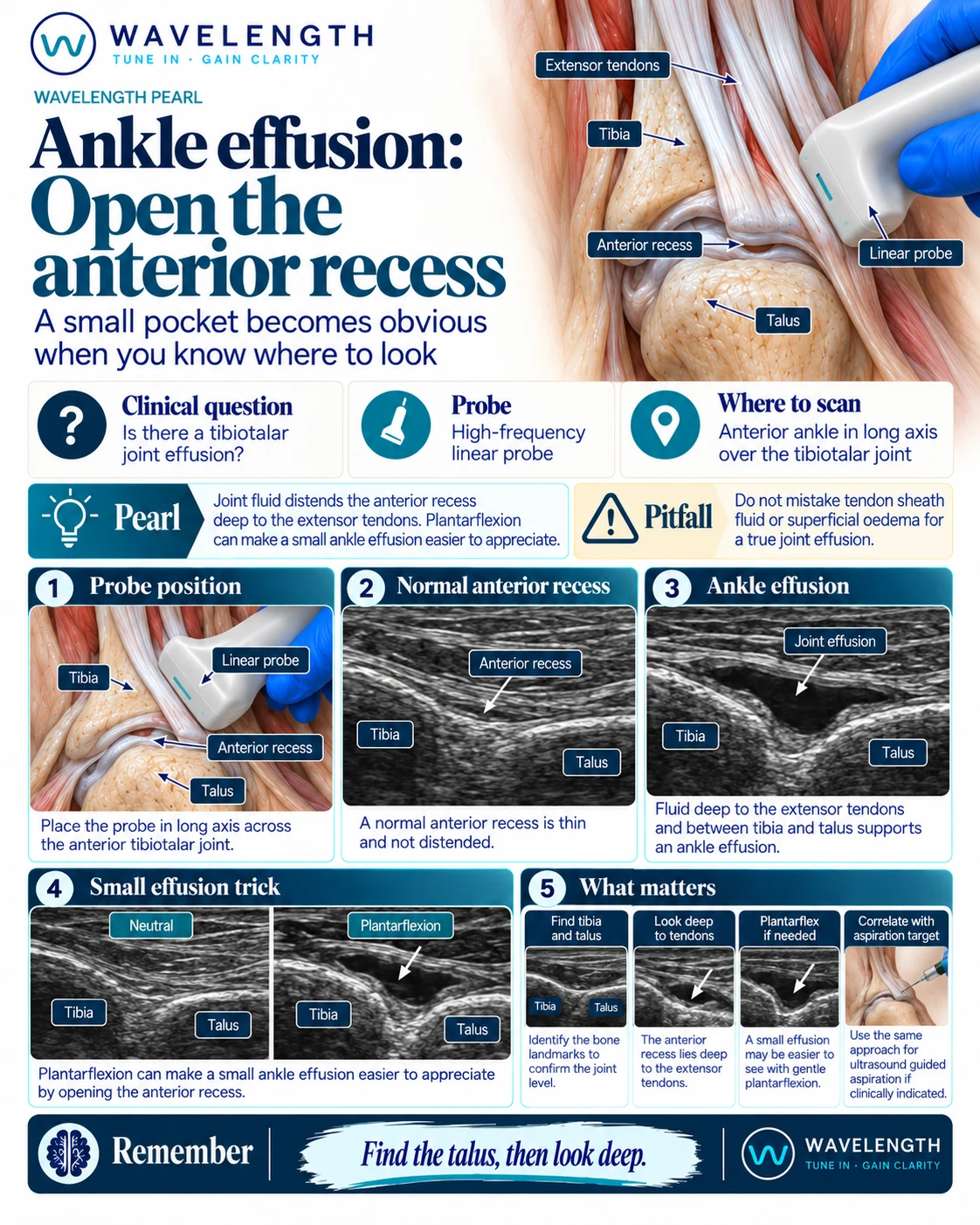
Scan images in the graphic are illustrations, not patient scans.
The scan
- Lie the patient supine with the knee bent and the foot flat on the bed, or slightly plantarflexed.
- Place a high-frequency linear probe in long axis over the front of the ankle, in the midline.
- Find the bright curve of the tibia, then the dome of the talus with its cartilage.
- Look deep to the extensor tendons, in the recess between the tibia and the talus.
- Plantarflex the foot gently. Fluid moves forward into the recess and becomes easier to see.
- Compare with the other ankle.
Reading the view
- Normal: a thin anterior recess, with at most a trace of fluid.
- Effusion: dark fluid distending the recess, deep to the tendons, between tibia and talus.
- Not the joint: fluid around a tendon is tenosynovitis, and swollen fat is oedema or cellulitis.
Action
A hot ankle with an effusion, especially with fever, needs aspiration for possible septic arthritis. Use the same view to guide the needle, avoiding the dorsalis pedis artery and the extensor tendons.