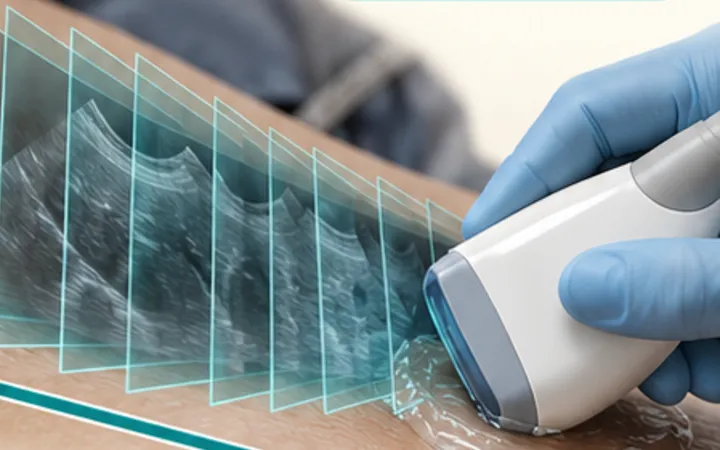
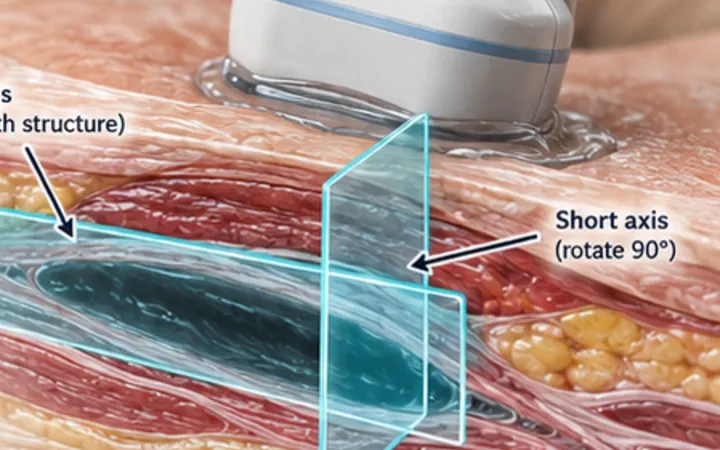
Colour Doppler shows the direction and average speed of flow in each small area of the colour box. When the flow is faster than the scale can show, the colour wraps round to the opposite end of the colour map. That is aliasing. It can point to a fast jet, but a scale set too low makes ordinary flow in a normal vessel alias too.
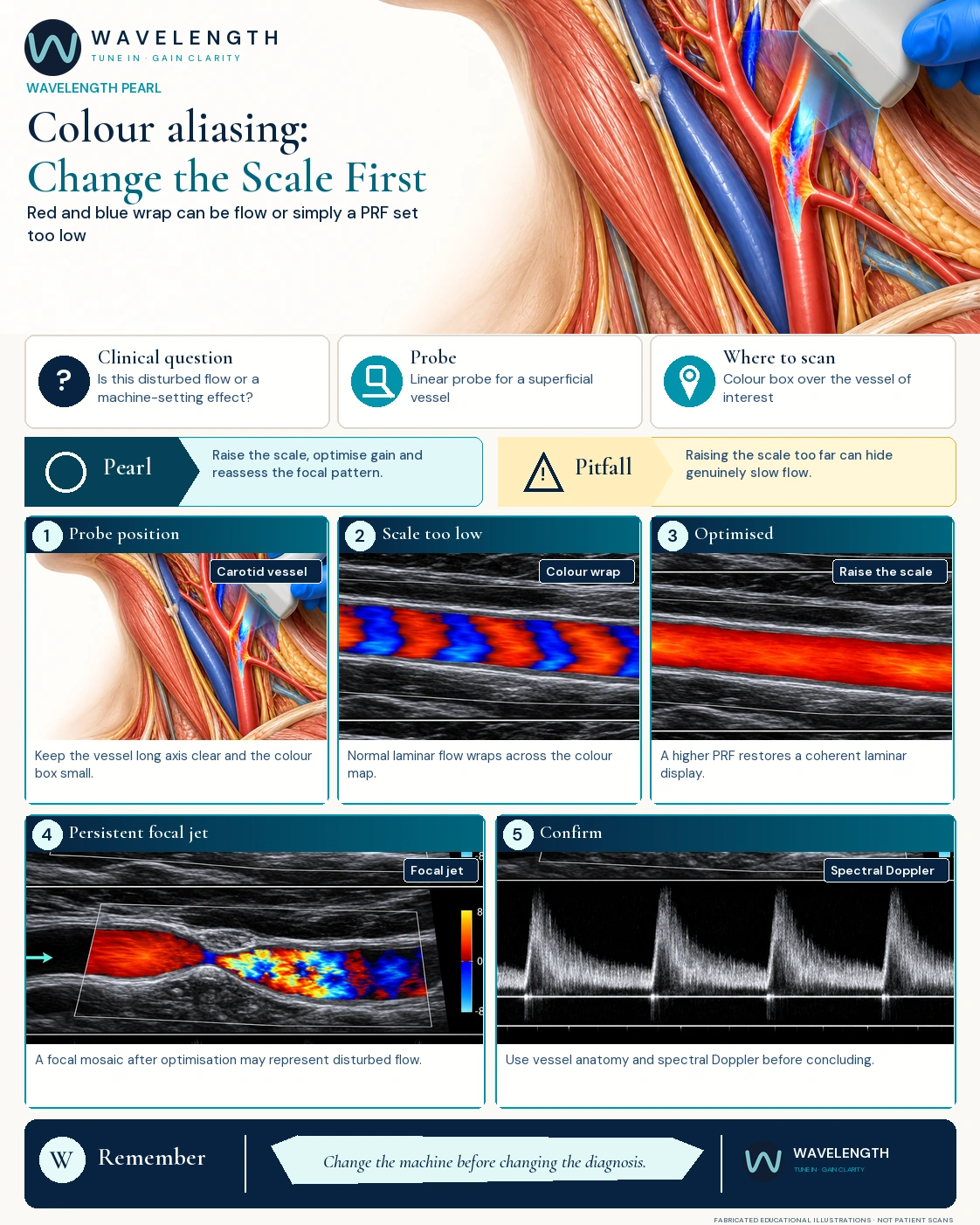
Scan images in the graphic are fabricated educational illustrations, not patient scans.
Set up before you interpret
- Keep the colour box small, over the vessel you care about.
- Turn the colour gain up until the lumen fills, then down until colour stops spilling outside the walls.
- Check the colour scale, also called the pulse repetition frequency (PRF). A very low scale makes normal flow alias.
- Raise the scale until smooth flow shows without wrap.
- Improve the angle. A beam at 90 degrees to the vessel shows little or no flow.
- If aliasing remains at one place, where the vessel narrows, use spectral Doppler and the full examination to describe it.
Reading the colour
- Red does not mean artery and blue does not mean vein. The colours show direction towards or away from the probe, depending on the colour map chosen.
- A whole normal-sized vessel flickering red and blue at a low scale is usually a settings problem.
- A focal mosaic jet at a narrowing can mean fast, disturbed flow, but colour alone does not grade a stenosis.
Action
Save the optimised colour image and, where it matters, an angle-corrected spectral waveform. Note the scale so the next scanner can reproduce the study.