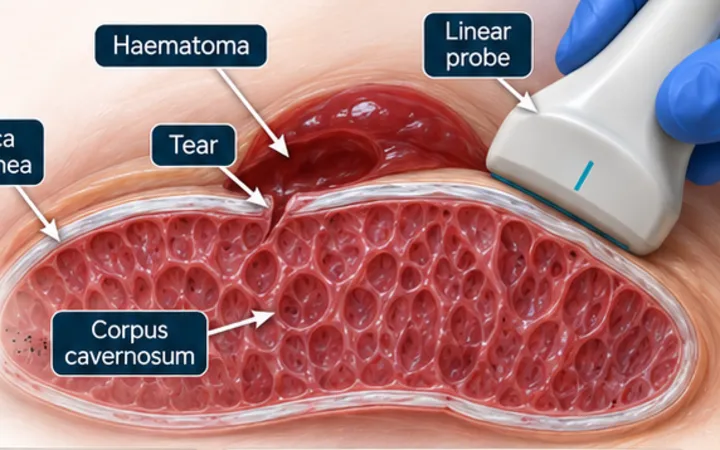
Priapism is an erection lasting more than four hours without sexual stimulation. Nearly all cases are ischaemic (low-flow): the blood in the corpora cannot drain, the corpora become a compartment syndrome, and after a few hours the smooth muscle starts to die. Causes include sickle cell disease, intracavernosal injections and drugs such as antipsychotics, trazodone and cocaine. Non-ischaemic (high-flow) priapism is rare: usually after a blow to the perineum or penis, an arteriolar fistula floods the corpora. It is painless and less rigid, and is not an emergency.
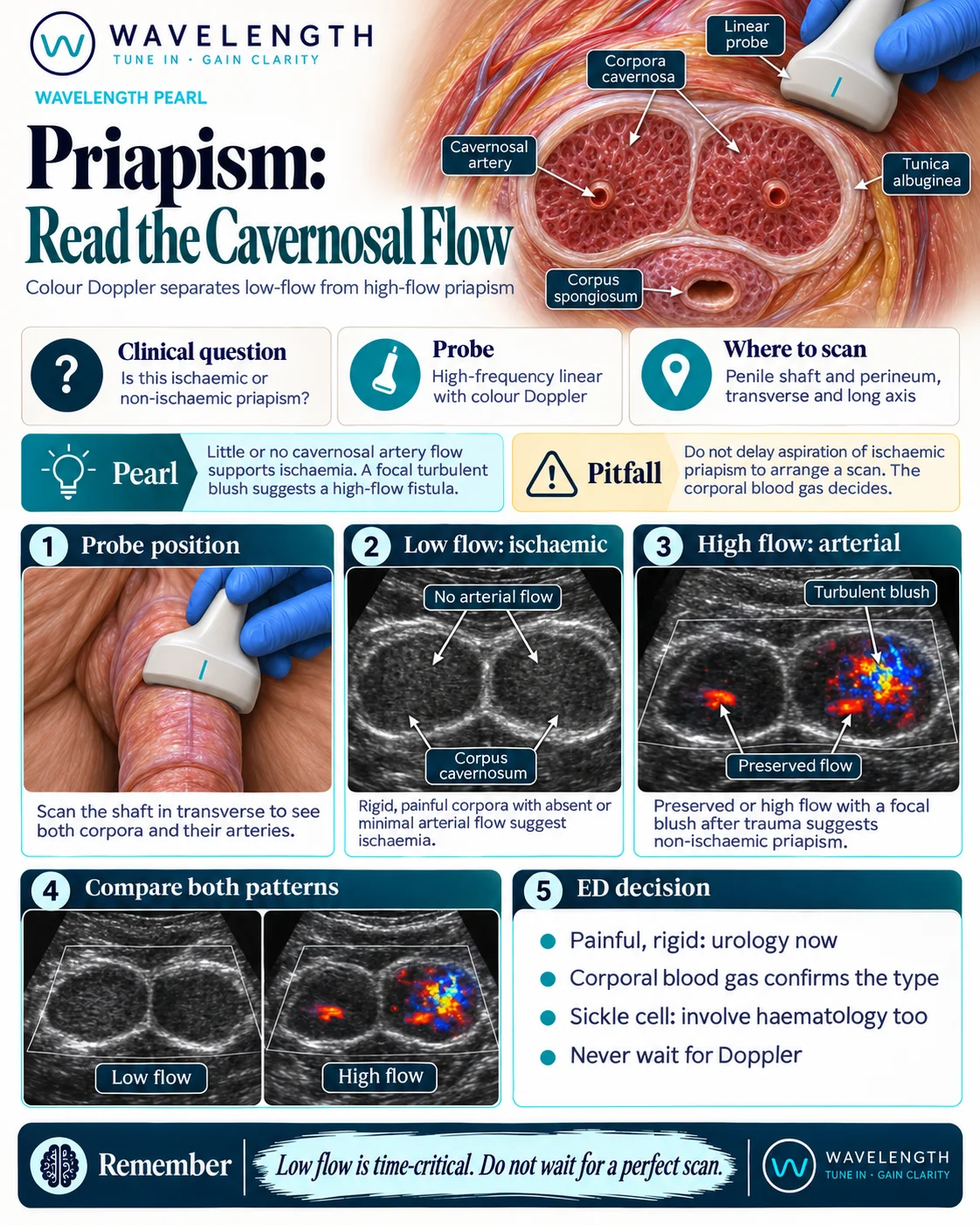
Scan images in the graphic are illustrations, not patient scans.
The scan
- Use a high-frequency linear probe with colour and spectral Doppler.
- Scan the shaft in transverse to see both corpora cavernosa, each with a cavernosal artery near its centre, and the corpus spongiosum around the urethra.
- Look for colour flow in each cavernosal artery, and sample it with spectral Doppler.
- Scan along the shaft and into the perineum, where the crura lie, looking for a focal blush of turbulent colour.
Reading the view
- Ischaemic (low-flow): rigid corpora with absent or minimal flow in the cavernosal arteries. Later, the corpora become heterogeneous.
- Non-ischaemic (high-flow): normal or high-velocity cavernosal flow, often with a focal turbulent blush where a fistula feeds the corpus, typically after trauma.
Action
Ischaemic priapism needs urgent urology: aspiration of the corpora, with irrigation and intracavernosal phenylephrine under monitoring, follows local guidance. In sickle cell disease, involve haematology too, without delaying treatment of the penis. Non-ischaemic priapism is referred to urology; many resolve, and embolisation is an option.