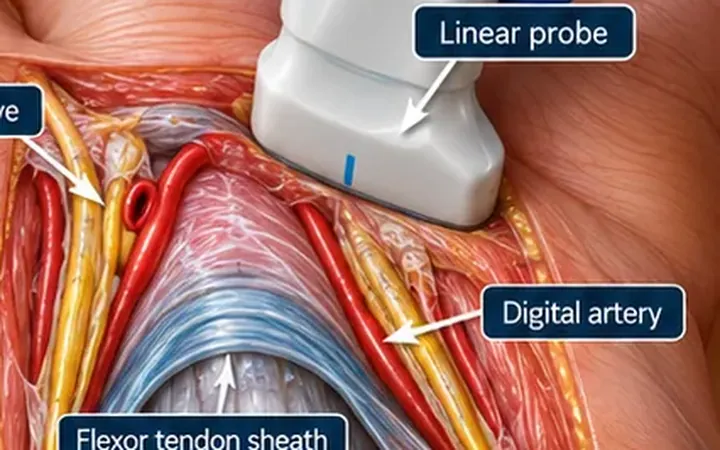
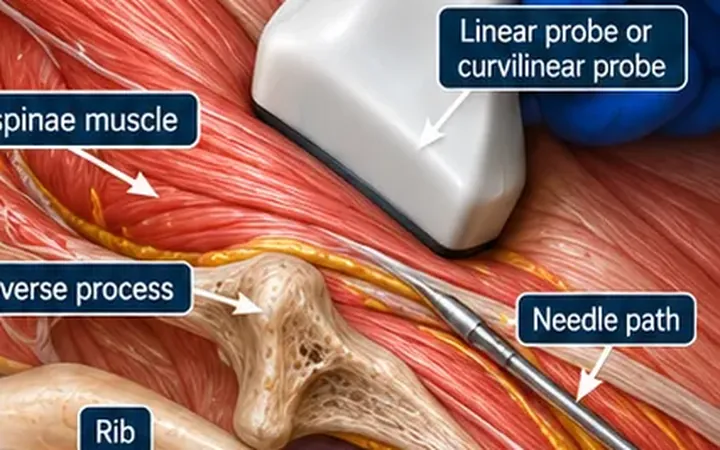
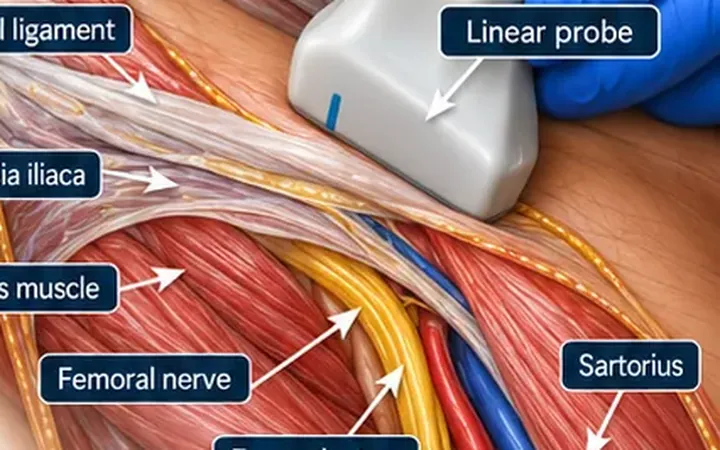
The front of the hip capsule receives its nerve supply from articular branches of the femoral nerve, the accessory obturator nerve and the obturator nerve. These branches run between the psoas tendon and the superior pubic ramus. The PENG block, described in 2018, places local anaesthetic in this plane. It treats pain from the joint rather than numbing the whole thigh, so it often leaves the quadriceps working.
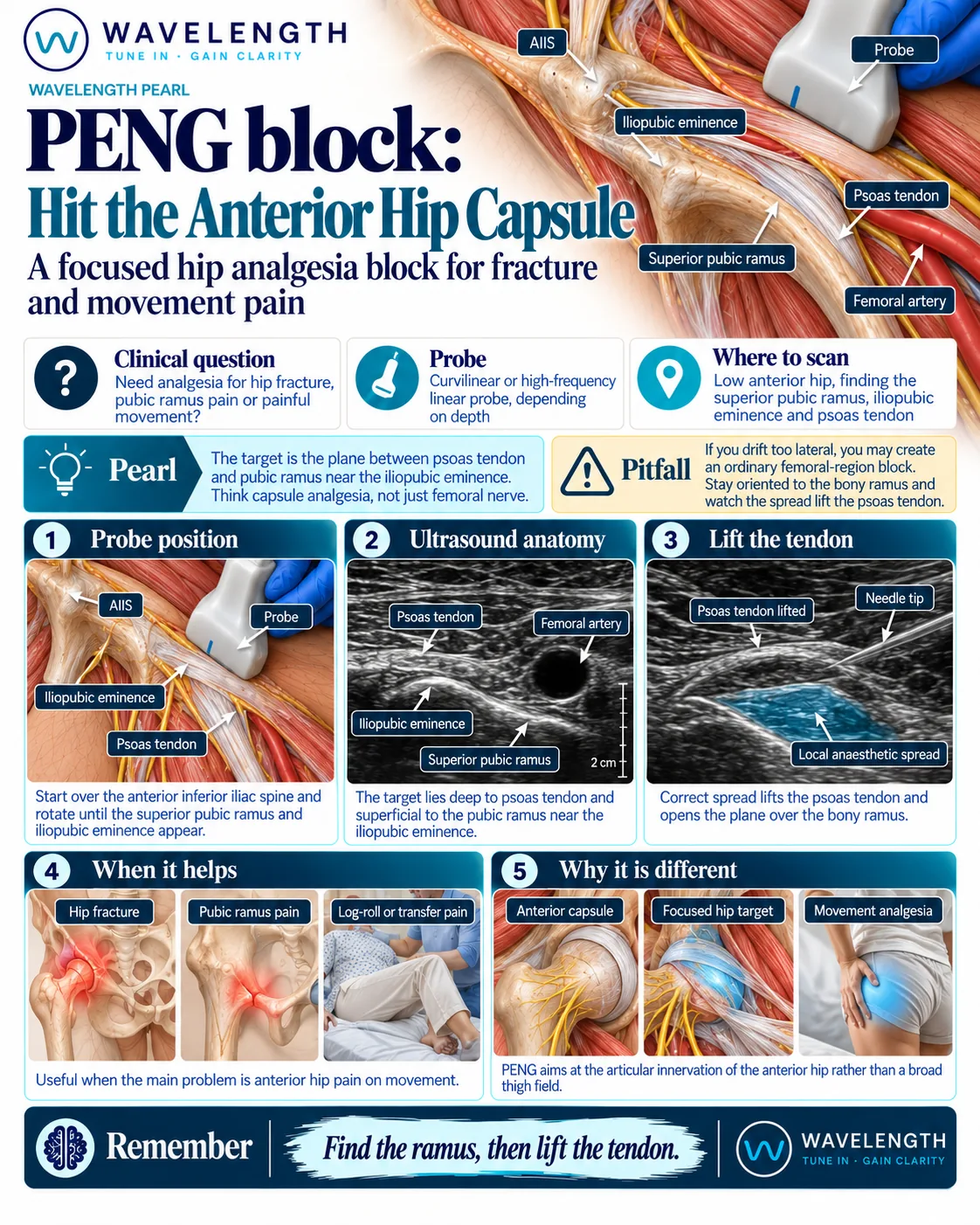
Scan images in the graphic are illustrations, not patient scans.
Before you block
- Record the neurovascular examination and consent.
- Calculate the maximum safe dose. The block usually uses about 20 mL.
- Attach monitoring and know where the lipid emulsion is.
The scan
- Lie the patient supine.
- Start with the probe transverse over the anterior inferior iliac spine. A curvilinear probe suits deeper patients.
- Rotate the probe about 45 degrees, so it lies parallel to the pubic ramus, and slide it until you see the iliopubic eminence, the psoas tendon on top of it, and the femoral artery on the medial side.
- Insert the needle in plane from lateral to medial, aiming for the plane between the psoas tendon and the pubic ramus.
- Inject 2 to 3 mL and watch the fluid lift the psoas tendon off the bone. Then inject the rest.
Reading the view
- Superior pubic ramus and iliopubic eminence. A bright, sloping bony line with a shadow below.
- Psoas tendon. A bright oval on top of the bone, with iliopsoas muscle around it.
- Femoral artery. Round and pulsating, on the medial side.
- Correct spread. Fluid between the tendon and the bone, lifting the tendon.