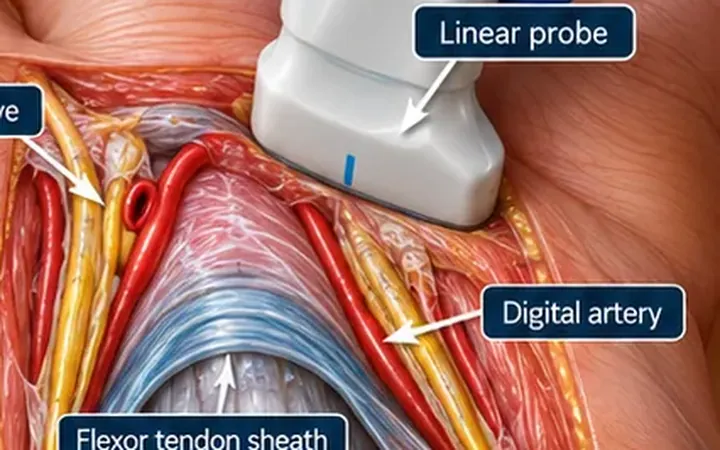
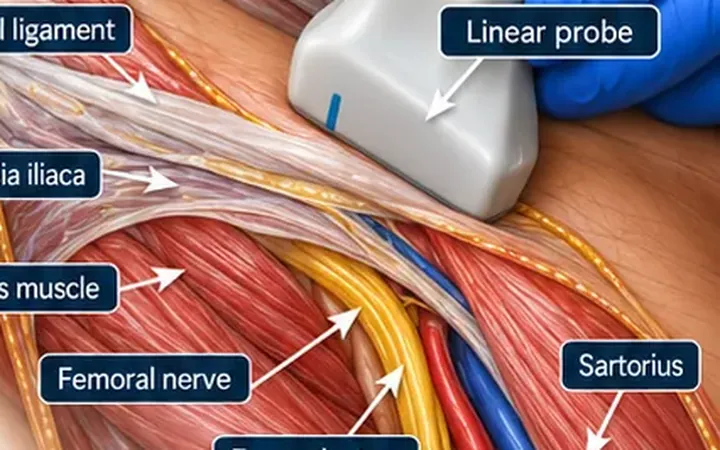
Palmar lacerations, foreign bodies and burns of the hand often need more than skin infiltration. A median nerve block in the forearm numbs the radial side of the palm and the palmar surface of the thumb, index, middle and half of the ring finger. It needs only a few millilitres, avoids distorting the wound and, combined with the ulnar and radial blocks, numbs the whole hand. A small emergency department study showed ultrasound-guided forearm blocks were feasible for hand procedures.
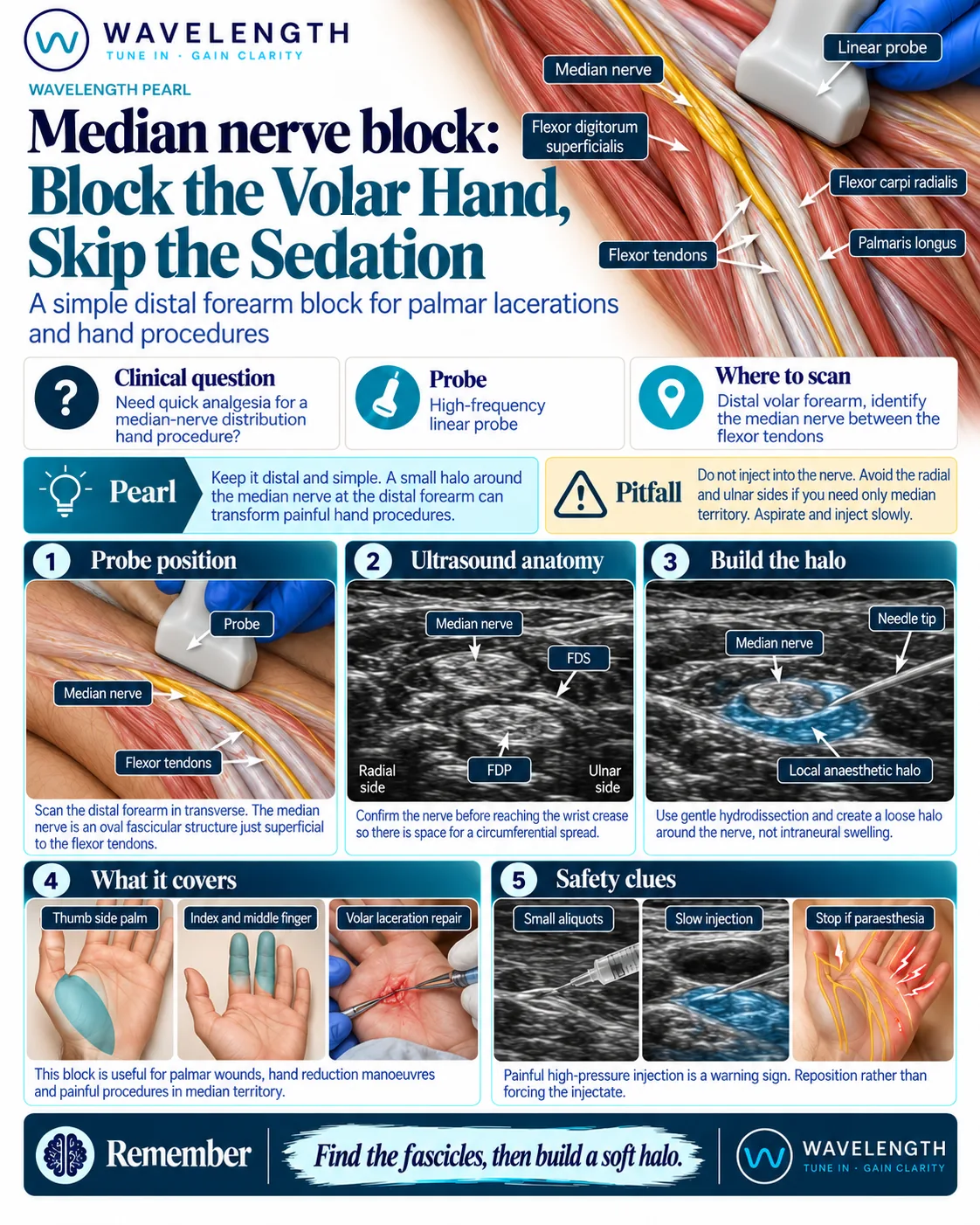
Scan images in the graphic are illustrations, not patient scans.
Before you block
- Record motor and sensory function in all three nerve territories, including two-point discrimination, before the block. A tendon or nerve injury must be documented first.
- Record consent and calculate the dose. Three to five millilitres per nerve is usually enough.
The scan
- Rest the forearm palm up on a support.
- Place the linear probe transversely on the front of the forearm, a few centimetres above the wrist crease.
- Identify the flexor tendons and look for the median nerve, an oval with a honeycomb texture, lying between flexor digitorum superficialis and profundus. Close to the wrist it moves superficial to the tendons.
- Slide up and down. The tendons change into muscle as you move up the forearm. The nerve keeps its honeycomb look all the way.
- Insert the needle in plane from either side, staying beside the nerve, not in it.
- Inject small amounts slowly, moving the tip above and below the nerve, until a ring of fluid surrounds it.
Reading the view
- Median nerve. A honeycomb oval which keeps its shape as you slide up and down.
- Tendons. Bright, fibrillar ovals which turn into muscle higher in the forearm.
- Correct spread. A dark ring, or halo, of fluid around the nerve.
- Wrong spread. The nerve itself swelling, or fluid collecting away from it.