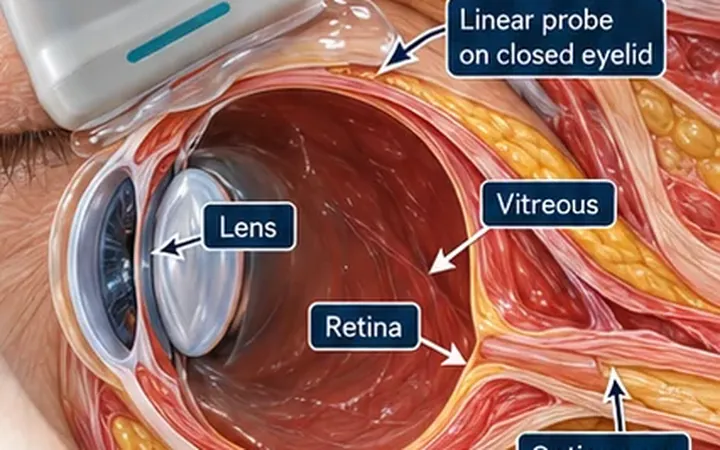
Testicular torsion twists the spermatic cord and cuts off the testis's blood supply. The chance of saving it falls with time. Sudden severe pain, vomiting, a high or horizontal testis and an absent cremasteric reflex need urology now, without waiting for a scan.
When a scan is done, the cord tells you more than the testis. In a 2018 meta-analysis by McDowall and colleagues, the whirlpool sign had a pooled sensitivity of 73% and a specificity of 99%.
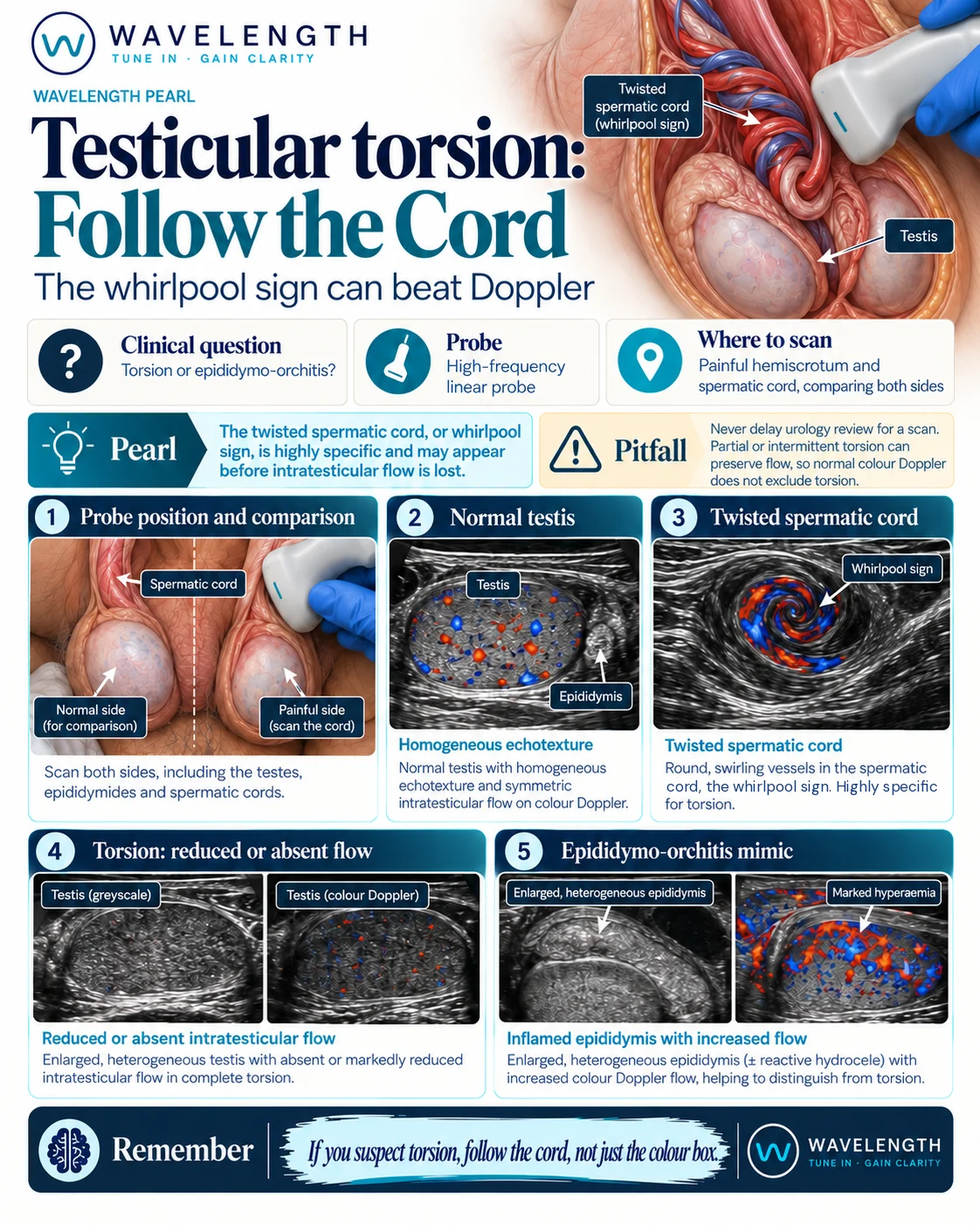
Scan images in the graphic are illustrations, not patient scans.
The scan
- Explain the scan, offer a chaperone and record the offer.
- Support the scrotum on a rolled towel. Use the linear probe with warm gel.
- Start on the painless side to set the grey-scale and colour settings.
- Look at each testis and epididymis in two planes.
- Compare flow in both testes with the same colour settings, scale set low.
- Follow the spermatic cord from the top of the testis up towards the groin, in short axis.
Reading the view
- Torsion: a twisted cord, a round mass with vessels spiralling into it, the whirlpool sign. Reduced or absent flow in the testis compared with the other side. An enlarged, uneven testis as it infarcts.
- Epididymo-orchitis: an enlarged epididymis with increased flow, often with a reactive hydrocele and a straight cord.