Procedural sedation for a dislocated shoulder ties up staff, a resuscitation bay and monitoring time. A superior trunk block numbs the shoulder while the patient stays awake. In one German emergency department, clinicians reduced 124 dislocated shoulders under low-volume superior trunk blocks of about 4 to 5 mL over six years. Every reduction succeeded, with no clinically relevant respiratory or haemodynamic complications reported. That study did not measure diaphragm function, so stay alert.
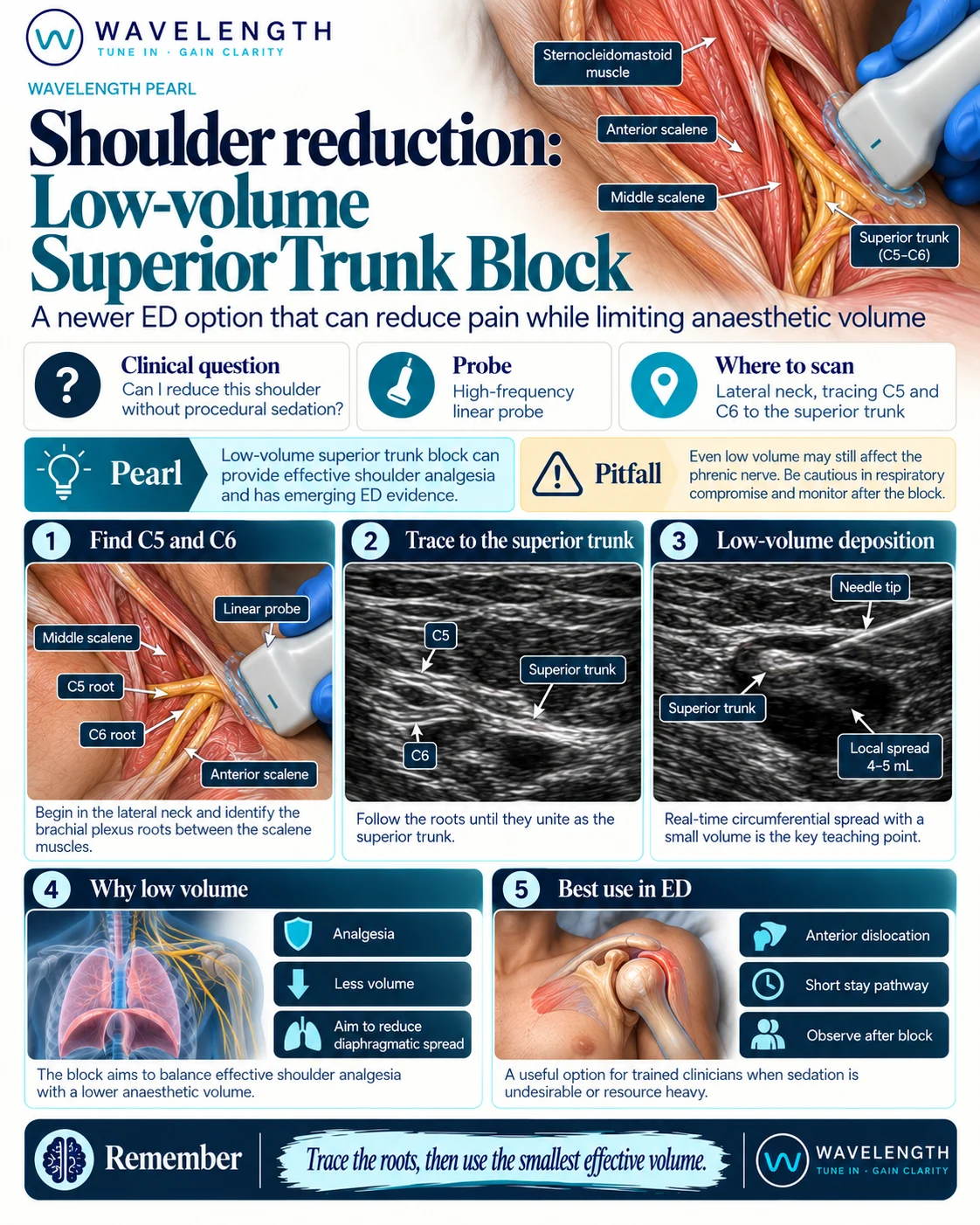
Scan images in the graphic are illustrations, not patient scans.
Why the superior trunk
The phrenic nerve runs close to the C5 root on the front of anterior scalene. An interscalene block at the roots paralyses the diaphragm on that side in most patients. The superior trunk lies further from the phrenic nerve. In a 2026 meta-analysis of eight surgical trials, superior trunk blocks reduced complete hemidiaphragmatic paralysis by about 90% compared with interscalene blocks. The risk falls, but it does not reach zero.
Before you block
- Confirm the dislocation and check for an associated fracture.
- Check the axillary nerve and the pulses, and record them.
- Do not use this block in patients with severe respiratory disease or a known paralysed diaphragm on the other side.
- Record consent, calculate a safe dose, attach monitoring and know where the lipid emulsion is.
The scan
- Sit the patient up, or lie them supine with the head turned away.
- Place the linear probe transversely on the side of the neck at the level of the cricoid.
- Find the roots as dark round circles stacked between anterior and middle scalene: C5, C6 and C7, the traffic lights.
- Follow C5 and C6 down towards the clavicle until they merge into one oval: the superior trunk.
- Insert the needle in plane from the lateral side, through middle scalene, and stop beside the trunk.
- Inject in small aliquots and watch the fluid surround the trunk.
Reading the view
- Roots. Dark round circles in a vertical stack between the scalene muscles.
- Superior trunk. The point where C5 and C6 join into one larger oval, before the suprascapular nerve leaves it.
- Good spread. A dark ring of fluid around the trunk.