The shoulder anterior capsular block, or SHAC block, targets the small nerve branches which supply the front of the shoulder joint. It works far from the neck, so it avoids the brachial plexus roots and the phrenic nerve. The team who described it in 2021 reported good pain relief without motor block in patients with painful shoulders. Evidence in emergency care, for dislocations and fractures of the upper humerus, is still limited to small reports. Treat it as an advanced option, under local governance.
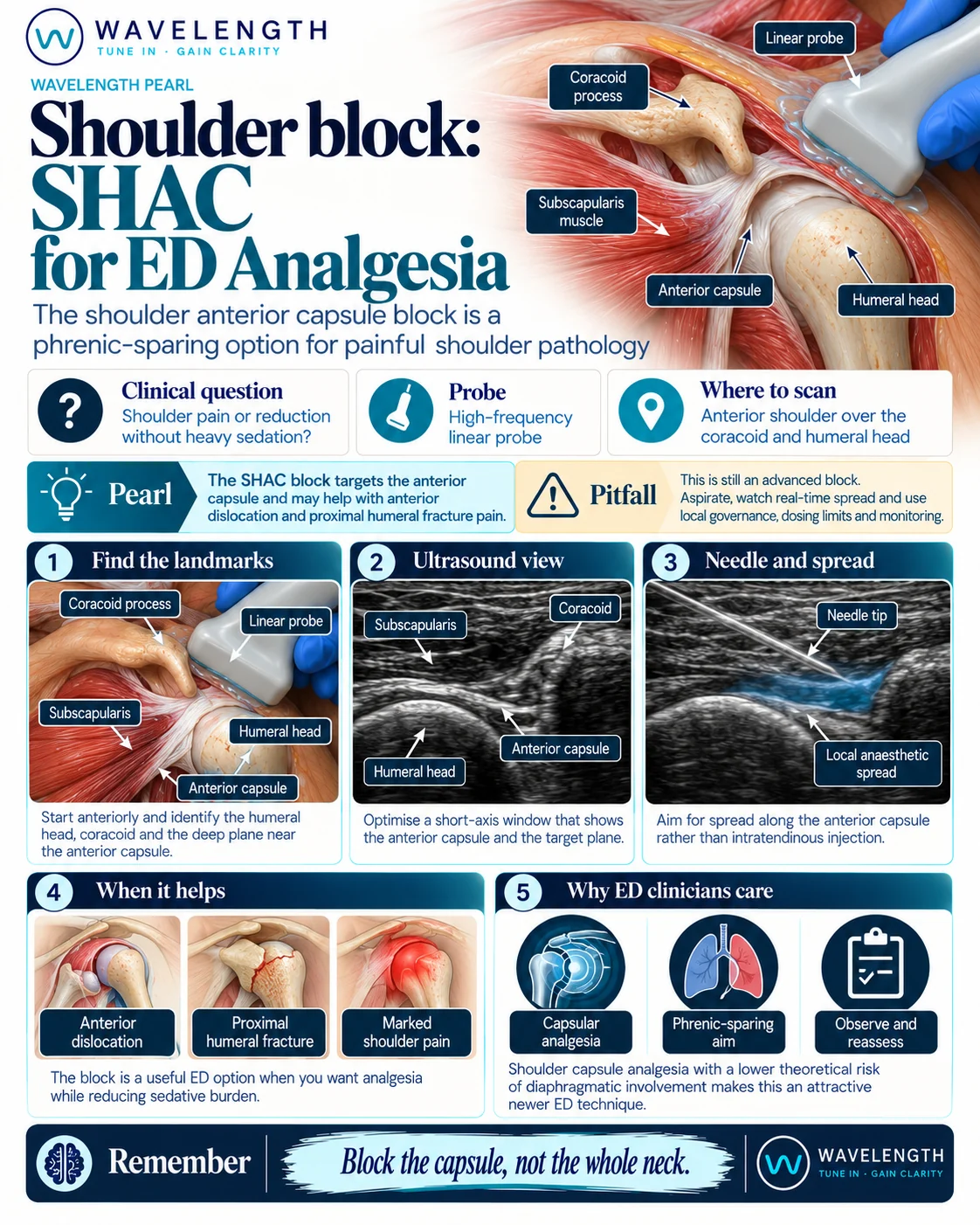
Scan images in the graphic are illustrations, not patient scans.
Before you block
- Confirm the diagnosis on X-ray and record the neurovascular examination.
- Record consent, calculate a safe dose, attach monitoring and know where the lipid emulsion is.
The scan
- Lie the patient supine with the arm by the side, in neutral or slight external rotation if comfortable.
- Place the linear probe transversely on the front of the shoulder, just below and lateral to the coracoid.
- Identify the coracoid, the round humeral head, the subscapularis tendon lying over it, and the deltoid above.
- Insert the needle in plane, keeping the shaft and tip in view, and aim deep to subscapularis onto the anterior capsule over the humeral head, lateral to the coracoid.
- Inject a small test dose and watch the fluid spread along the capsule, under the tendon.
Reading the view
- Coracoid. A bright bony curve with a shadow, on the medial side of the image.
- Humeral head. A larger bright curve with the capsule lying on it.
- Subscapularis. A fibrillar band running across the front of the humeral head.
- Good spread. A thin dark layer of fluid between the tendon and the capsule.