Rib fractures near the spine sit outside the reach of a serratus anterior plane block. The erector spinae plane block, described in 2016, places a larger volume under erector spinae, on the transverse process. The fluid spreads over several levels and reaches the dorsal rami and, to a variable extent, the ventral rami of the spinal nerves. The target is bone, a long way from the pleura, which makes it a simple block to learn. Evidence in rib fractures is growing but mixed. Use it within your trust's governance.
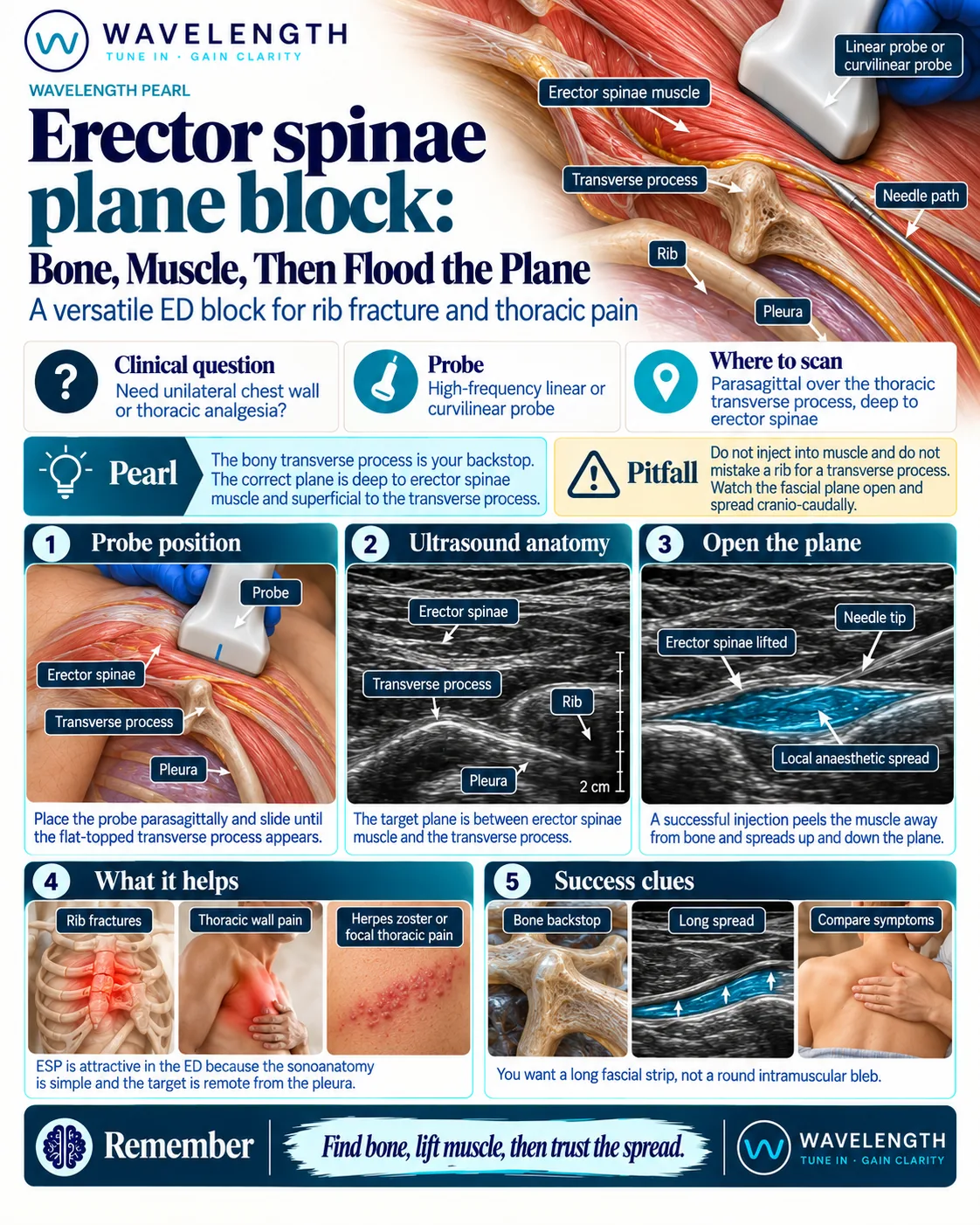
Scan images in the graphic are illustrations, not patient scans.
Before you block
- Check for a pneumothorax on ultrasound or X-ray.
- Record consent, calculate the maximum safe dose (20 to 30 mL is typical), attach monitoring and know where the lipid emulsion is.
- Sit the patient up or lie them on the uninjured side.
The scan
- Place the probe in a sagittal plane at the level of the fracture, over the midline, to see the spinous processes.
- Slide laterally, about 3 cm from the midline, until the bony line changes from the rounded laminae to the square, flat-topped transverse processes.
- Slide further lateral briefly to see the rounded ribs with pleura between them, then slide back to the transverse processes. This confirms you are on the transverse process, not a rib.
- Insert the needle in plane from the top or bottom of the probe until it touches the transverse process, deep to erector spinae.
- Inject 2 to 3 mL and watch the fluid lift the muscle off the bone and spread along the plane. Then inject the rest.
Reading the view
- Transverse process. A square, flat-topped bright line with a dense shadow below.
- Rib. A rounder bright line, further lateral, with the pleura visible between ribs.
- Erector spinae. The thick muscle above the bone.
- Correct spread. A long strip of fluid lifting the muscle off the bone and travelling up and down.