Ectopic pregnancy remains a leading cause of early pregnancy death. In the emergency department, point-of-care ultrasound answers a narrow question well: is there a definite intrauterine pregnancy? When the answer is no, the scan does not stop at the uterus.
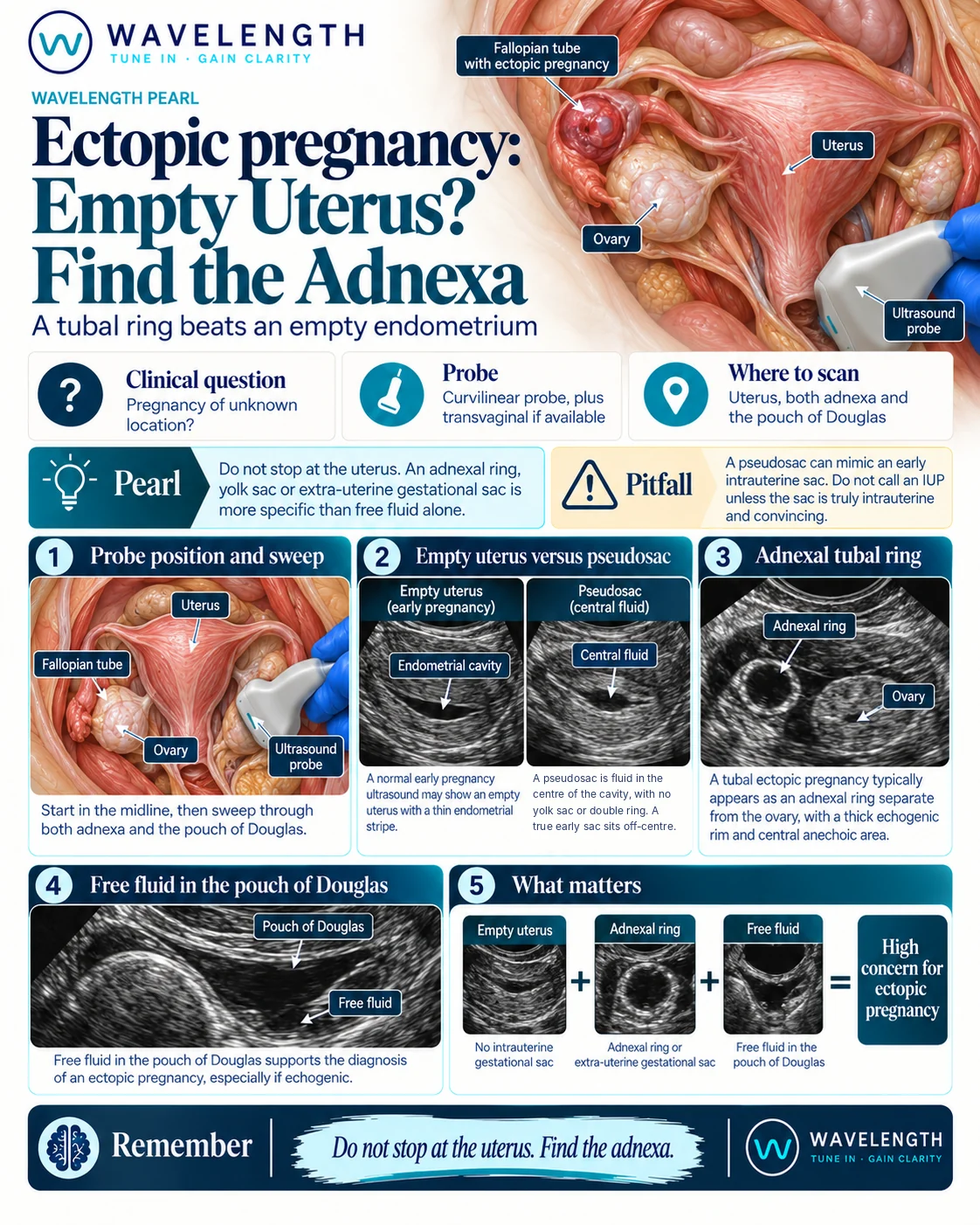
Scan images in the graphic are illustrations, not patient scans.
The scan
- Confirm a positive pregnancy test first.
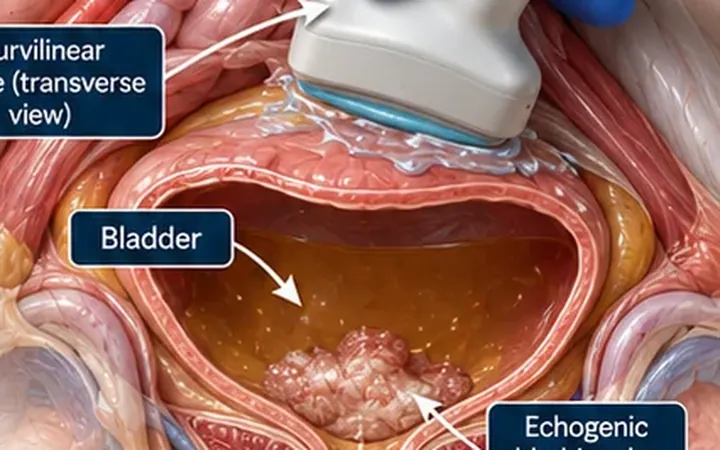
- Scan transabdominally with the curvilinear probe, ideally with some urine in the bladder. Find the uterus in sagittal, then sweep side to side, then turn to transverse.
- Look for a gestational sac inside the endometrium that contains a yolk sac or a fetal pole, surrounded by myometrium on all sides.
- Sweep through both adnexa, beside the uterus, looking for a ring or mass separate from the ovary.
- Look behind the uterus in the pouch of Douglas for free fluid.
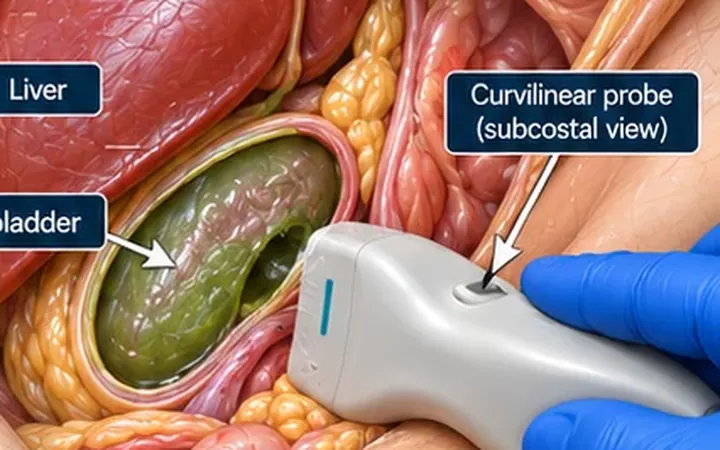
- In an unstable patient, scan the right upper quadrant for free fluid in Morison's pouch.
Reading the view
- Intrauterine pregnancy: a sac in the uterus containing a yolk sac or fetal pole. Without these, do not call it an intrauterine pregnancy.
- Pseudosac: fluid in the centre of the endometrial cavity, with no yolk sac and no double ring. A true early sac sits off-centre, within the endometrium.
- Tubal ring: a thick, bright ring separate from the ovary, sometimes with a yolk sac or fetal pole inside.
- Free fluid: echogenic fluid in the pouch of Douglas suggests blood. Fluid in Morison's pouch with a positive pregnancy test means a large bleed.
What to do next
An unstable patient with a positive pregnancy test and free fluid needs immediate senior and gynaecology involvement for theatre. A stable patient without a confirmed intrauterine pregnancy has a pregnancy of unknown location and needs your early pregnancy unit pathway, formal transvaginal scanning and serial hCG. Patients after IVF can have an intrauterine and an ectopic pregnancy together.