A hot, painful shoulder raises concern for septic arthritis, which is easy to miss in a deep joint. The posterior recess is the most reliable place to find glenohumeral fluid, and the same view guides aspiration.
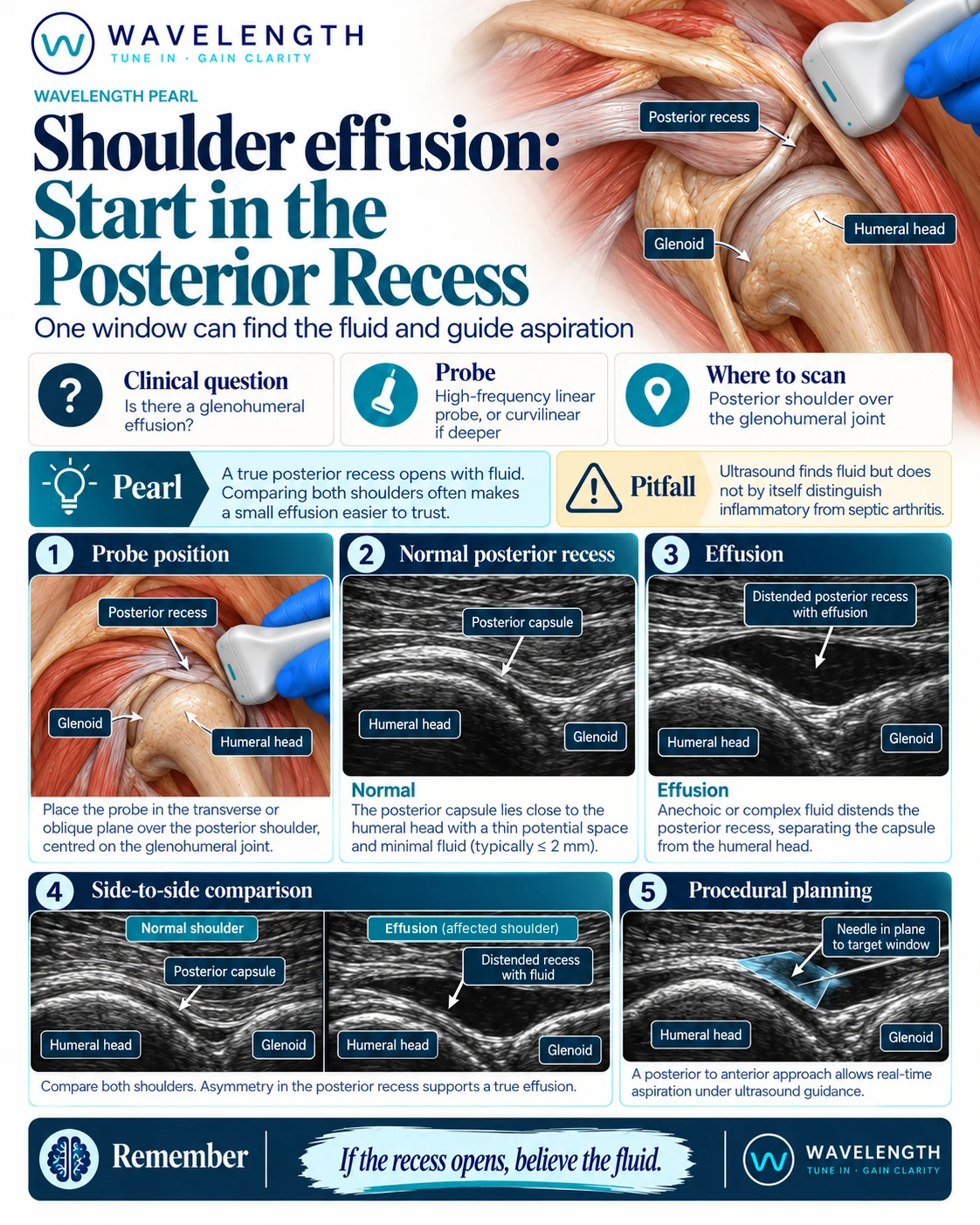
Scan images in the graphic are illustrations, not patient scans.
The scan
- Sit the patient up and stand behind them, with the forearm resting on the lap.
- Use the linear probe, or the curvilinear probe in a larger patient.
- Place the probe just below the scapular spine, parallel to it, and slide laterally to the back of the joint.
- Find the glenoid, the humeral head lateral to it, and the posterior labrum between them.
- Look at the capsule over the back of the humeral head. Then rotate the arm outwards, keeping the elbow by the side. External rotation moves fluid into the posterior recess.
- Scan the other shoulder with the same settings.
Reading the view
- Normal: the capsule lies close to the humeral head, with at most a thin dark line, usually 2 mm or less.
- Effusion: a dark space lifts the capsule off the humeral head and bulges outwards.
- Comparison: a recess clearly wider than the other side supports a true effusion.
Guided aspiration
From behind, insert the needle in plane from lateral to medial, aiming for the space between the humeral head and the glenoid. Use full aseptic technique and watch the tip enter the fluid. Send fluid for microscopy, culture and crystals.